Get Full Government Meeting Transcripts, Videos, & Alerts Forever!
Get email alerts on the City Budget Projection topic
No spam. Unsubscribe anytime.
Baltimore council hears FY26 first‑quarter projection showing small general‑fund gap and large public safety deficits
Summary
City budget staff told the Council's Budget & Appropriations Committee the FY26 first‑quarter projection shows a $3.3 million general‑fund deficit driven by a $12.4 million expenditure shortfall; revenue surpluses in income and property taxes partly offset the gap, while large projected deficits remain in police and fire budgets.
Chairwoman Danielle McCray convened the Baltimore City Council Budget & Appropriations Committee to hear the city's first‑quarter fiscal 2026 budget projection. "We are projecting a $3,300,000 deficit in the city's general fund," City Budget Director Laura Larson said, attributing the gap to a $12.4 million projected expenditure deficit offset in part by a $9.1 million revenue surplus.
Larson told council members the largest revenue upside is income tax: the administration budgeted $493 million for FY26 but now projects $510 million, "which would result in a $16,500,000 surplus." Property tax revenue is also modestly above budget, with the FY26 property tax estimate rising from $1.2 billion to $1.21 billion, a $13.8 million positive variation driven by reassessments at several large properties, including a Harbor Point reassessment Larson said generates about $8.9 million in new recurring revenue.
At the same time, other revenue lines are weaker. Larson called transfer and recordation taxes the largest shortfall, reporting a projected $94.6 million versus a $104.8 million budgeted figure, a $10.2 million deficit driven by a roughly 9.7% decline in transaction counts year over year. Hotel tax receipts are also down, she said, from a $28.5 million budget to a $24.9 million projection largely because occupancy and average nightly rates have declined.
On the expenditure side, Larson said uncertainty tied to the timing and costs of nine pending union contracts required the office to build assumptions for wage and backpay liabilities into agency budgets. She also detailed agency‑level projections: the Fire Department faces about a $25.6 million deficit, and the Police Department has an estimated $414.9 million projected deficit driven by sworn overtime and obligations tied to a recently ratified contract. City Schools carried a roughly $1 million shortfall tied to an unexpected state payment for pre‑K that was not factored into the budget until after finalization.
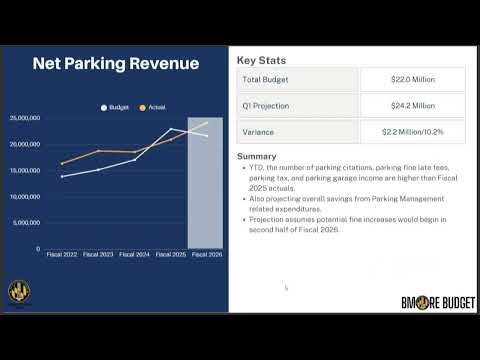
Committee members pressed for follow‑up detail. Larson said MOED had budgeted 8,500 YouthWorks slots for FY26 and that 7,600 participants completed the summer program — meaning 900 funded slots were not filled to completion — and she committed to a written follow‑up explaining reasons for noncompletion. On traffic cameras, Larson said revenue projections assume a 52% year‑of‑issue collection rate and that long‑run collection for camera citations is roughly 70–75%.
The budget office will update the committee with second‑quarter projections and the administration flagged potential supplemental appropriations tied to any surplus found within DOT's capital program. Council members requested additional written responses on YouthWorks participation, the effect of Virginia vehicle tags on local registration revenues, and detailed counts of eliminated positions versus hires.