
Commissioners approve inflation-adjusted annual payout from domestic-violence trust to DVAC; ask for clearer trust records and process
Get AI-powered insights, summaries, and transcripts
Subscribe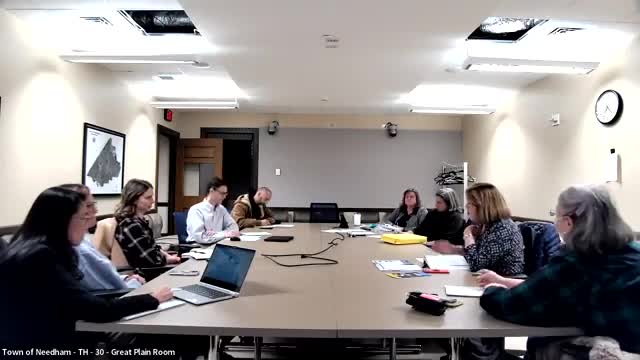
Summary
The Town of Needham commissioners approved an inflation-adjusted annual disbursement to the Domestic Violence Action Committee (DVAC) and agreed to clarify trust-document rules and public access to scanned binders; commissioners also urged creation of an indexed, searchable trust inventory and legal guidance on donor privacy.
At a recent meeting of the Town of Needham commissioners, the board approved an annual, inflation-adjusted disbursement from a trust established for domestic-violence services to the Domestic Violence Action Committee (DVAC) after committee co-chairs described ongoing program needs.
Maureen Callahan, director of development and public relations for the community council, told commissioners the nonprofit runs Needham-only programs including a food pantry, English-language classes, medical transportation and a dementia-care partner-support program and said the group is “all privately funded” and exploring options to sustain or expand services.
Laura Duff, a public health nurse and co-chair of DVAC, presented the committee’s request. Duff said DVAC sought an annual amount “adjusted for inflation” compared with prior disbursements; staff materials and discussion referenced last fiscal-year disbursements of about $8,100 and an inflation-adjusted request near $8,550.
Commissioners reviewed the trust’s history and spending rules. Commissioners said the trust-authorizing letter, dated 09/07/2004, specified annual payments and that the trust’s market value discussed in the meeting was about $502,000. The commission explained that a common approach for preserving a fund in perpetuity is a spending rule near 4% annually, but that the DVAC request represents roughly 1.7% of the cited balance and therefore would not exhaust the fund under that interpretation. A commissioner said, “I would recommend over time not exceeding 4% per year,” while noting boards can approve larger, project-specific withdrawals if the trustees follow the disbursement process.
The commissioners also addressed public access to trust records. Members confirmed binders of trust documents were scanned but not yet indexed or made searchable; they raised concerns that some scanned material may contain personally identifying information (canceled checks, Social Security numbers) and discussed the need to redact private data or consult town counsel before posting files widely. One participant said she had tried for months to obtain access to the binders and had been unable to do so; commissioners agreed to investigate the access issue and to consider a documented policy for how community groups make proposals to the commission.
On procedure, the chair asked DVAC to notify the commission in writing when the committee’s advisory or reporting relationship changed (for example, formalizing an advisory role to the director of health and human services). The chair then called for a motion to approve the annual disbursement; the motion passed on a voice vote with no roll-call tally recorded. The chair summarized the commission’s direction: staff will reread the specific trust documents before issuing formal guidance and will pursue legal counsel and Town Council input on donor-privacy limits if necessary.
The commission closed the agenda by approving prior minutes, taking up routine invoicing work and setting tentative dates for upcoming meetings. The disbursement approval was the substantive outcome of the session; commissioners said they would provide DVAC with guidance on whether to treat the amount as an ongoing annual payout or to submit separate disbursement requests for larger projects.
What’s next: DVAC indicated it will take the guidance back to its committee and may return with a request for additional funds for specific programming; commissioners said they would prepare a searchable index of trust documents and consult town counsel to clarify what portions of trust records can be publicly posted.