
Needham working group reviews three redesign alternatives for town center, debating bump‑outs, slip lane and parking tradeoffs
Get AI-powered insights, summaries, and transcripts
Subscribe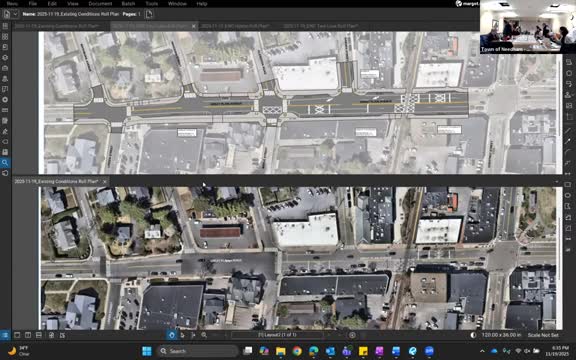
Summary
At its Nov. 19 meeting the Envision Needham Center Project Working Group reviewed block‑by‑block plans for three alternatives (4‑lane, hybrid, 2‑lane), focusing on curb extensions, a contentious slip lane at Dedham Avenue, and minor net changes to on‑street parking.
The Envision Needham Center Project Working Group met Nov. 19, 2025, to review detailed block‑by‑block role plans for three concept alternatives for Great Plain Avenue and surrounding blocks and to discuss trade‑offs for pedestrian safety, parking and vehicular operations.
Presenter (Speaker 3) opened the corridor review, saying the project limits begin just west of Linden Street and Washburn Avenue and that each alternative uses curb extensions at crossings to shorten crosswalk exposure and clarify where drivers may legally park. "We're identifying opportunities to provide curb extensions or curb bump outs wherever there is a crossing," the presenter said, noting the measures both shorten pedestrian exposure and clearly delineate parking boundaries.
Speakers pressed the project team on specific trade‑offs. Speaker 1 explained the safety benefit: moving a pedestrian onto a bump‑out gives both driver and pedestrian better sightlines. "If they're out on the bump out, both the car and the pedestrian can see each other," Speaker 1 said. The group discussed examples where proposed bump‑outs reduce legal parking in one block by one or two spaces while enabling two spaces to be added nearby on Garden Street or Grapevine Avenue.
The Dedham Avenue slip lane drew sustained attention. Presenter (Speaker 3) said all three alternatives propose eliminating the exclusive right‑turn slip lane and instead accommodate right turns as part of the signal phase. Speaker 4 asked whether showing a version that retains the slip lane for public feedback would be possible; Speaker 1 said it could be shown but would change traffic modeling and safety characteristics because a signalized slip lane alters turning movements and queuing.
Members also discussed the railroad crossing and quiet‑zone requirements. Presenter (Speaker 3) noted that flex posts and pavement markings in the center of the roadway align with quiet‑zone plans and that new pedestrian gates and emergency egress space are part of quiet‑zone standards, not strictly part of the corridor project.
The working group agreed to continue studying the geometries and to run mock‑ups (cones and vehicle walkthroughs with the fire department and bus operators) to verify turning radii and emergency access before final design decisions. The meeting closed with direction to circulate revised materials and to include the slip‑lane option for review in public materials where feasible.
The next steps include refined traffic modeling and a diversion analysis expected to be completed in the coming weeks, plus circulation of an updated evaluation matrix for review at the next meeting.