
Assessors brief council: $7.3M new growth led by utilities and personal property; HERO Act doubles veteran exemptions but state reimbursements unchanged
Get AI-powered insights, summaries, and transcripts
Subscribe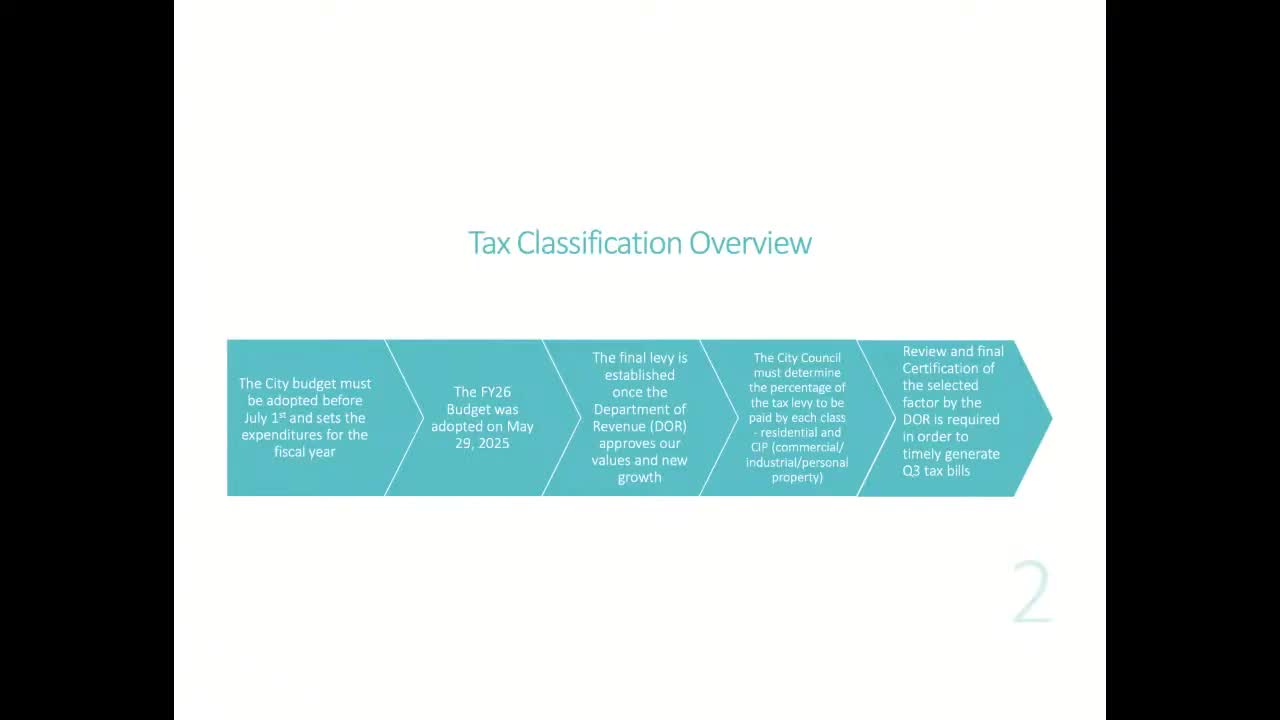
Summary
City staff told the council that Springfield recorded just over $7.3 million in new growth for FY26—56% from personal property—driven largely by utilities and a few commercial projects; the HERO Act doubled veteran exemptions but state reimbursement did not increase, and the mayor committed $1,000,000 in free cash toward targeted relief.
City staff presented valuation, new-growth and exemption data to the Springfield City Council on Nov. 24 as part of pre-vote briefings on the tax levy and proposed tax rate.
Jessica (assessor's office staff presenting slides) said Springfield has approximately 45,979 taxable parcels and personal-property accounts. For fiscal 2026 the city reported just over $7.3 million in new growth: 56% attributable to personal property, 18% residential and 26% commercial/industrial. Jessica told the council utilities—"like Eversource"—and updates to outmoded infrastructure account for much of the personal-property increase.
The presentation reviewed Proposition 2½ levy mechanics and the Department of Revenue’s (DOR) role: certification of assessed values occurs every five years (the last certification was in fiscal 2023) while municipalities must submit interim updates annually. Staff reported FY26 valuation and status dates as Jan. 1, 2025 (valuation date) and June 30, 2025 (physical status date), and said the city’s overall taxable value rose by about 7.81% for FY26.
On exemptions, Jessica summarized the personal-exemption programs: Clause 41C (for those 65+ with asset and income tests), Clause 17D (for certain older homeowners or surviving spouses), blind homeowner exemptions, and veterans exemptions. Fiscal 2025 included about 1,100 exemptions totaling roughly $951,000; the state reimbursed just over $755,000. "For fiscal 26, the HERO Act doubled the exemption amount for veterans," Jessica said, "and the amount that we are being reimbursed from the state did not change. The state reimbursements are also subject to annual appropriation."
Jessica also detailed a proposed targeted tax-relief donation fund and creation of a taxation-aid committee to set eligibility; a home-rule petition would allow the city to put money into that fund. The mayor has committed $1,000,000; staff showed a penny-rate sheet estimating an average single-family tax increase of $288 under an initial scenario and $244 after an additional $3,000,000 in free cash.
Councilors asked clarifying questions about why personal property accounted for the largest share of new growth; Jessica repeated that utilities drive much of that category and that it is a multi-year trend. The presentation concluded with the council preparing to rejoin the full meeting for the scheduled 5:00 p.m. vote; the transcript does not record the actual vote or its outcome.