
Keith Harper recounts Cobell trust litigation, calling it 'a trust is a trust'
Get AI-powered insights, summaries, and transcripts
Subscribe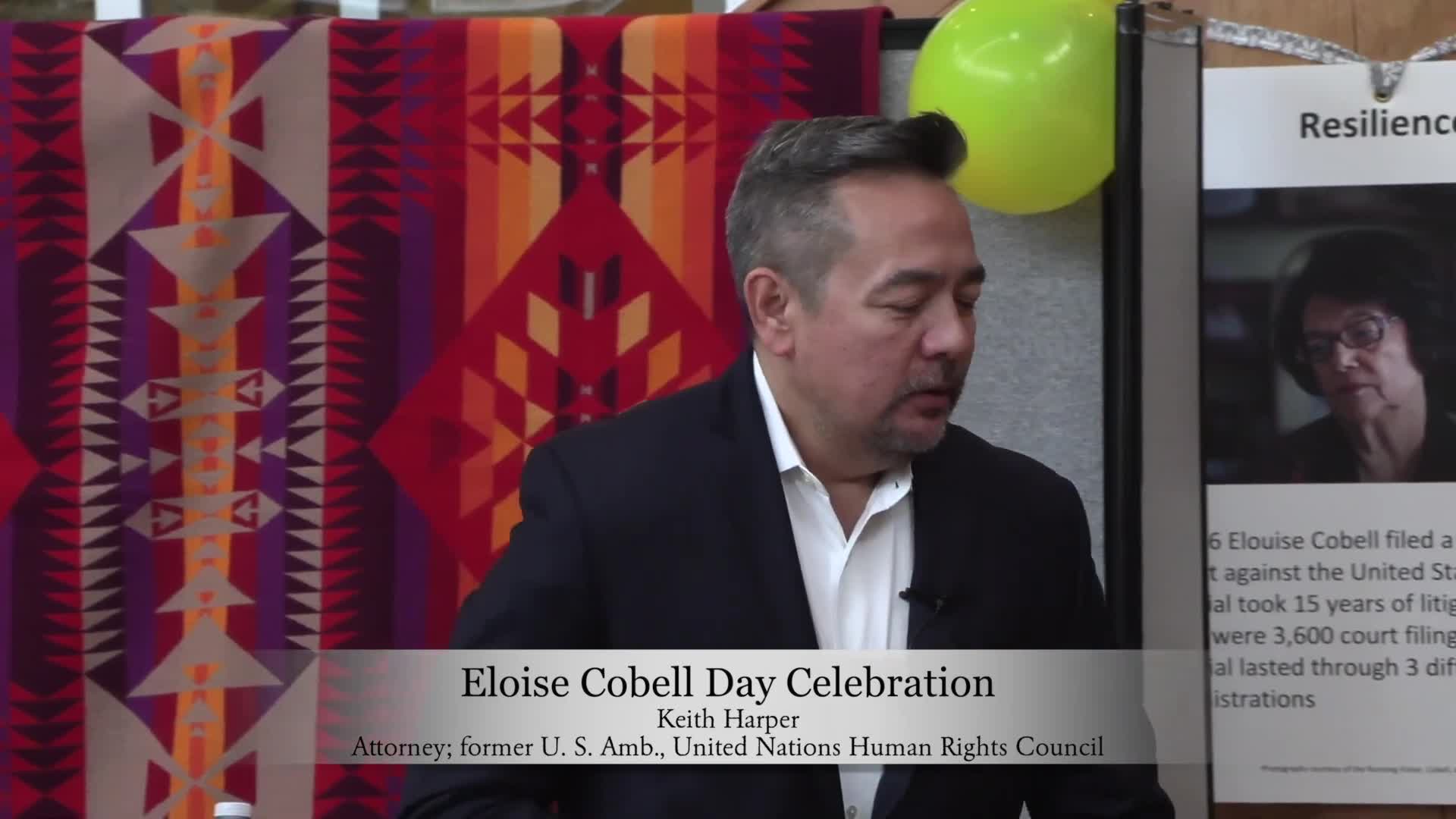
Summary
Attorney Keith Harper told a Missoula gathering that the Cobell litigation, filed in June 1996, forced the federal government to provide trust accounting and produced a roughly $3.4 billion settlement and a $60 million scholarship fund; he described strategy, court fights and continuing limitations for beneficiaries.
Keith Harper, who served as lead counsel in the Cobell litigation and later as U.S. ambassador to the U.N. Human Rights Council, told attendees at an Eloise Cobell Day event in Missoula that the lawsuit’s central strategy was simple: treat Indian trust accounts like any other fiduciary trust. "A trust is a trust," Harper said, summarizing the legal narrative that steered the case.
Harper traced the problem to policies beginning with the 1887 General Allotment Act and a long history of mismanagement, collusion and documented federal failures. He said early congressional reports — including a 1915 report cited in his remarks — described fraud and institutional incompetence that persisted for decades and left millions of acres and thousands of individual Indian Money (IIM) accounts without reliable accounting.
The litigation, Harper said, began after community organizing led by Eloise Cobell and the Intertribal Monitoring Association; Cobell and tribal leaders sought fixes through hearings and Congress before filing suit. Harper said the decision to seek an accounting in federal district court — rather than money damages in the Court of Federal Claims — was deliberate: district court allowed equitable remedies and a clearer path to class certification.
Harper described the procedural arc: the case was filed in June 1996, tried in the late 1990s, and produced rulings that the United States had breached trust duties. He credited Judge Royce C. Lambert for recognizing the injustice and for taking extraordinary steps — including findings of contempt against senior officials — that raised the case’s profile. Harper said the litigation produced many published decisions and protracted appeals before settlement negotiations resumed.
Negotiations ultimately yielded a settlement Harper described as about $3.4 billion, including roughly $60 million carved out for a Cobell scholarship fund. Harper stressed the settlement did not fully redress generations of lost wealth — "$3.4 billion doesn't come close to compensating the class" — but said it represented the practicable result given the limits of litigation against the federal treasury. He said much of the settlement money has been distributed and that trust accounting systems and rules are markedly improved since the litigation, though imperfections remain: "They never did an accounting," he said of the government’s prior practice, and the improved accounting today is imperfect but far better than before Cobell.
In audience questions, Harper offered concrete examples of undervaluation — citing right-of-way payments on the Navajo reservation that averaged about $9 to $11 per rod while off-reservation rates were commonly $47 to $95 per rod during the period at issue — and explained why the government’s reconciliation-style audits (the transcript cites Arthur Andersen’s work) differed from fiduciary accounting standards. He also described the practical scale of the case: roughly 500,000 class members, a small plaintiff-side team (Harper estimated 4–8 lawyers at times) and a far larger government team at peak staffing.
Harper closed by noting the litigation’s broader legacy: increased transparency for beneficiaries, changed federal attitudes toward tribal governance, and a generation of tribal successes that followed in the era of self-determination. The keynote concluded with Harper opening the floor to additional questions.