
Sawyer County zoning committee denies hot-mix asphalt plant at Skilly Pit, approves early renewal for the pit
Get AI-powered insights, summaries, and transcripts
Subscribe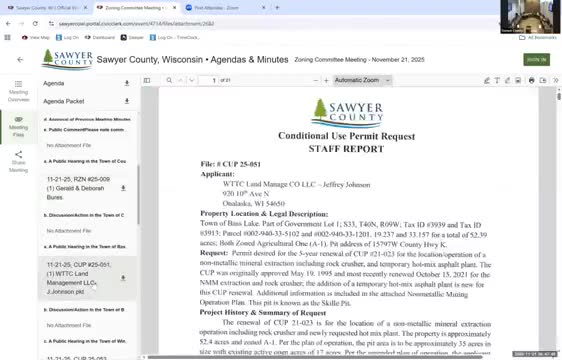
Summary
After extended public comment and legal guidance on evidentiary standards, the Sawyer County Zoning Committee approved an early renewal for the Skilly pit’s nonmetallic mining and rock-crushing permit but voted 3–2 to deny the addition of a temporary hot-mix asphalt plant.
The Sawyer County Zoning Committee on Nov. 5 approved an early five-year renewal for the nonmetallic mineral extraction permit at the Skilly pit but separately denied a request to add a temporary hot-mix asphalt plant.
The renewal — which includes an acreage amendment and standard conditions listed in the staff report — passed by roll call after committee members said the pit and rock-crushing operation are long-standing local resources needed for road construction and other projects. Committee members noted the operation’s financial assurance bond and prior permits as part of the record.
The committee then took a separate motion on the proposed temporary hot-mix asphalt plant. Opponents said the plant would worsen noise, create diesel and tar odors, emit volatile organic compounds and particulate matter, increase heavy-truck traffic on County K and harm property values and tourism. “Adding an asphalt plant will bring tar odors, diesel fumes and VOC emissions,” said Tracy Yackel, a nearby property owner, urging denial. Several other residents recounted hearing and feeling vibration from existing rock-crushing operations and asked the committee to reject the asphalt permit.
Applicant representatives from Milestone Materials and Monarch Paving described the plant as a portable, temporary operation that would be used only for nearby DOT projects and subject to Wisconsin DNR air permits and third‑party emissions testing. Tristan Gardner, representing the applicant, said the company does not intend to convert the temporary plant into a permanent facility and encouraged the committee to limit operations to a 16‑week window as a condition.
Rebecca Roker of Atollis Law told the committee that the statutory standard for reviewing conditional use permits requires “substantial evidence” to justify approval or denial and that testimony from residents can count as evidence when it reflects direct personal knowledge (noise, odors, vibration). The committee debated whether the written record and testimony met that standard for either action.
When members voted on the asphalt-plant question the denial passed 3–2. The minutes record members Kaye Wilson, Ron Buchholz and Tweed Schuman voting to deny and Dale Magnuson and Steve Cariannon voting against denial. The committee’s earlier approval of the renewal explicitly excluded authorization for the asphalt plant.
Next steps: the renewal (without the asphalt plant) stands under the conditions the committee adopted; the applicant would need to seek separate approvals if it later wishes to pursue a temporary asphalt operation that meets the committee’s evidentiary concerns.