SBCC legislative committee weighs delaying 2024 code implementation, seeks legislative remedy
November 24, 2025 | Building Code Council, Governor's Office - Boards & Commissions, Executive, Washington
This article was created by AI summarizing key points discussed. AI makes mistakes, so for full details and context, please refer to the video of the full meeting. Please report any errors so we can fix them. Report an error »
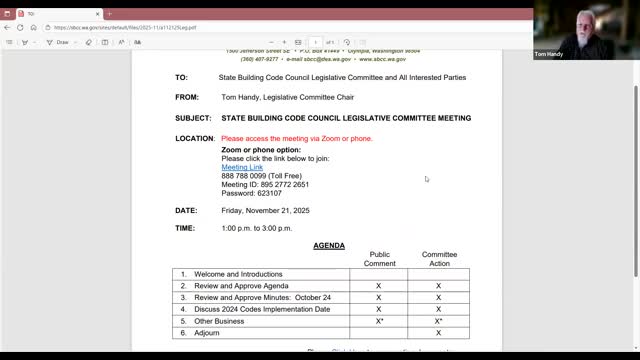
Why it matters: the council previously identified a November 1 implementation date, but statutory language that rules must "sit through" the legislative session means final adoption could shift the effective date to a month after sine die unless the Legislature changes the statute. That statutory constraint would delay implementation to about May 1, 2027 if the current language is enforced, council members said. Dustin outlined an administrative schedule that would require filing CR102 by Feb. 18, opening a public comment window that would close around Apr. 18 and a council CR103 filing/vote at the council's May meeting.
Committee members pressed on timing and user readiness. Industry and training stakeholders said producing Washington‑specific code books and preparing statewide training are time‑intensive: WAVO volunteers provided hundreds of hours last cycle, and training developers need several months to prepare courses and materials. Dustin said a six‑month turnover from final adoption to implementation might be achievable with more staff and concurrent (rather than fully sequential) work; otherwise the publication and training pipeline typically requires longer lead time.
Representative Rommel said he would pursue legislation to provide flexibility for this cycle or to remove the statutory requirement that rules sit through the full legislative session. He also suggested promoting use of an approved-but-not-yet‑implemented 2024 code as a code alternative for building officials who want to adopt early. "If that's something that you want to change, then propose legislation to change that," Michael Transu (representing the Washington Aggregate and Concrete Association) said, urging the committee not to ignore existing statutes.
Members discussed targeted remedies, such as: a temporary waiver for the 2024 cycle; drafting narrower statutory language focused on implementation timing; or using expedited or off‑cycle rulemaking to bring legislatively mandated items (for example, single‑exit and multiplex housing provisions) into effect on schedule. Some members argued for more structural reforms—like changing the 3‑year adoption cycle—while others warned that a longer cycle could forfeit opportunities to adopt emerging technologies and would require rebuilding volunteer capacity.
Next steps: Representative Rommel said he will begin drafting legislation and invited Dustin and committee members to provide feedback. The committee agreed to document its findings and report to the SBCC executive committee while continuing to prepare CR102 materials on the administrative timeline. The meeting closed with Dustin noting the practical filing windows and staff capacity constraints that will determine whether the council can preserve an earlier implementation date.
View the Full Meeting & All Its Details
This article offers just a summary. Unlock complete video, transcripts, and insights as a Founder Member.
30-day money-back guarantee
Sponsors
Proudly supported by sponsors who keep Washington articles free in 2025

