
Research and nonprofit projects highlight schools as high-value sites for stormwater capture in Los Angeles County
Get AI-powered insights, summaries, and transcripts
Subscribe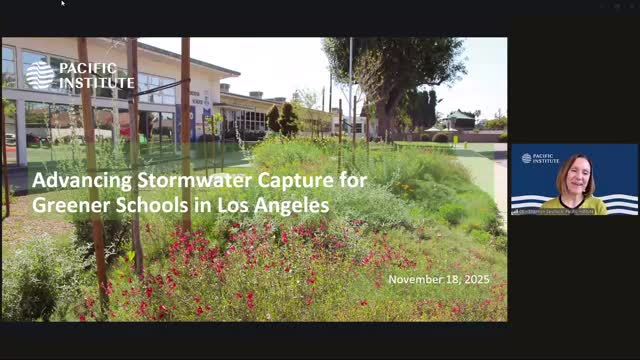
Summary
The Pacific Institute presented a countywide analysis showing LA public school campuses produce billions of gallons of runoff annually and that targeted school greening could capture a significant share; community groups described successful Title I school projects and urged technical assistance and O&M funding.
Researchers from the Pacific Institute told the State Water Resources Control Board that school grounds across Los Angeles County could be important locations for stormwater capture and multiple co‑benefits. Shannon Spurlock and Sonali Abraham presented a framework and spatial analysis using the RainStored tool (Second Nature) to estimate volumetric capture potential and rank campuses by water‑supply, water‑quality, flood‑reduction and urban‑heat mitigation benefits.
Key quantitative finding reported to the board: LA County public school campuses generate approximately 3,150,000,000 gallons of runoff per year (~9,500 acre‑feet). The Institute estimated roughly 2,000,000,000 gallons/year of that volume could potentially be captured and reused to augment water supplies and support campus greening without raising municipal demand.
Claire Robinson of Amigos de los Rios described more than two decades of on‑the‑ground school greening projects focused on Title I schools: removing asphalt, installing pervious pavement, bioswales and rain gardens, planting trees, adding interpretive signage and integrating curricula. Robinson said such projects provide measurable benefits — reduced flooding, more usable outdoor space, heat mitigation and educational opportunities — but must be paired with technical assistance and reliable O&M funding to succeed long term.
Board members pressed presenters about environmental‑justice overlays, methods to map heat‑vulnerable campuses and the need for state or federal technical assistance programs so smaller districts can apply for grants and complete initial feasibility and design work. Presenters said the research has the capacity to add an EJ overlay but needs funding to operationalize it; nonprofit implementers reinforced that targeted technical assistance and training are critical to build a pipeline of shovel‑ready school projects.
The meeting produced no formal action. Presenters asked the board and funding agencies to prioritize multi‑benefit criteria in grant scoring and to support technical assistance to help schools develop projects that meet both educational and stormwater objectives.