
State Water Board workshop spotlights regional stormwater credit programs and calls for statewide guidance
Get AI-powered insights, summaries, and transcripts
Subscribe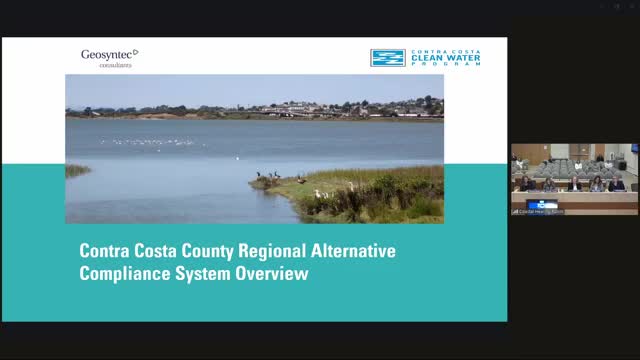
Summary
At a State Water Resources Control Board workshop, Contra Costa, Anaheim and other regional programs described off-site compliance and credit-banking models that finance larger green stormwater infrastructure projects; presenters urged statewide templates, CFD mechanisms for O&M, and consistent MS4 permit language to scale programs equitably.
Contra Costa County and Anaheim officials told the State Water Resources Control Board on Nov. 20 that regional "credit" programs — where large off-site green stormwater infrastructure (GSI) projects generate compliance units that developers or municipalities can buy — can accelerate water-quality improvements and finance long-term operations.
Lisa Austin and Rinta Parkins of Geosyntec, presenting the Contra Costa Regional Alternative Compliance (REC) system, described a framework in which sellers (public agencies or private entities) build off-site GSI, generate "equivalent acres greened" compliance units based on pollutant-reduction formulas, and sell those units through a joint powers authority (JPA). Buyers pay upfront capital to construct those projects and contribute to a Community Facilities District (CFD) to fund long‑term O&M. The REC team said phase one (framework and pilot exchanges) is complete, 12 of 21 member agencies have signaled interest in a JPA, and the program hopes to begin exchanges in fiscal 2026–27 with a full rollout by FY 2028–29.
Keith Linker, Anaheim’s stormwater program manager, described his city’s credit bank and its first credit generator, Majesco Park, which captures roughly 150 acre‑feet per year from a 220‑acre drainage area. Anaheim said it has sold nearly $5 million in credits so far and emphasized program design choices that affect feasibility: larger trading-area watersheds reduce the risk of stranded credits and speed credit availability, while overly small watershed definitions in MS4 permit language can delay or block program development.
Speakers and several public commenters urged the State Water Board to provide clearer statewide guidance: model JPA and CFD documents, standardized equivalency calculations, templates for reporting, and recommended watershed delineation methods to avoid regulatory fragmentation. Multiple presenters also recommended that any off‑site compliance system require buyers to contribute to long‑term O&M up front and suggested the board consider a statewide advisory or technical committee to support jurisdictions launching similar programs.
The workshop also featured a coalition effort, the Stormwater Credit Think Tank, which has produced a white paper, glossary and roadmap to help regions design credit systems. Advocates and municipal staff said those resources can reduce duplicative work regional agencies otherwise face when negotiating legal and technical details with attorneys, public works directors and regional boards.
Next steps described at the meeting include continued pilot exchanges, broader stakeholder outreach, and requests that the board consider issuing model documents and permitting guidance to reduce legal and administrative barriers to regional trading.
No formal board actions or votes occurred during the workshop; presenters requested follow-up technical support and clearer state templates to help local programs scale.