
Researchers, nonprofits urge school‑ground stormwater projects to deliver water, heat mitigation and equity benefits
Get AI-powered insights, summaries, and transcripts
Subscribe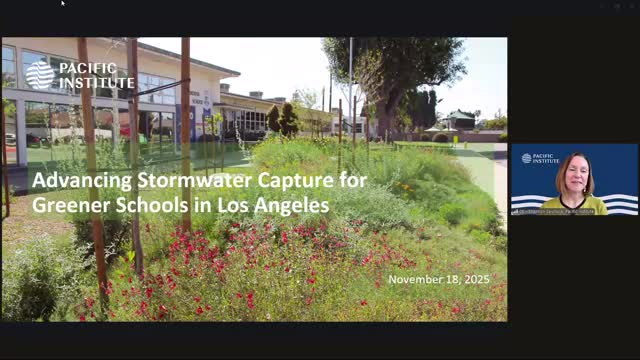
Summary
Pacific Institute research estimates LA County public school campuses generate ~3.15 billion gallons of runoff/year and could capture ~2 billion gallons to augment supplies, reduce heat and provide community green space; presenters recommended partnerships, technical assistance, and prioritizing Title I schools to realize multiple co‑benefits.
Shannon Spurlock and Sonali Abraham of the Pacific Institute presented research and a planning framework for prioritizing stormwater capture on school grounds. They argued school campuses — especially in large districts like LAUSD — are distributed public landholdings that can provide multiple benefits including water supply augmentation, pollutant reduction, flood mitigation and urban heat‑island relief, while also serving as living classrooms.
Sonali Abraham presented quantitative results using a spatial tool (Rainstored): the team estimated total stormwater runoff from Los Angeles County public school campuses at approximately 3,150,000,000 gallons per year (about 9,500 acre‑feet). Of that amount, about 2,000,000,000 gallons per year could potentially be captured to augment water supplies and help green campuses without increasing demand on regional potable supplies. Their county‑level analysis found school campuses account for roughly 2.4% of urban runoff volume in LA County; benefits and capture potential vary by watershed, creating a rationale to prioritize schools by co‑benefits (water supply, water quality, flood reduction, heat mitigation).
The Pacific Institute emphasized partnership models: technical collaborators (Second Nature), community partners (Council for Watershed Health, Trust for Public Land LA), and school districts. They recommended engagement with students, staff and families to ensure local ownership and maintenance plans.
Claire Robinson of Amigos de los Rios described 22 years of implementation in Title I schools: pervious pavement, bioswales, rain gardens, tree plantings and interpretive signage. Robinson highlighted nontechnical barriers — maintenance responsibilities (“who is the mom of the project?”), costs for site investigations and geotechnical testing, and the importance of nonprofit technical assistance and community buy‑in — and presented case studies where school transformations reduced flooding and created educational amenities.
Board members and presenters agreed on two near‑term needs: targeted technical assistance for districts and explicit incentives in permit metrics or funding programs to prioritize projects in disadvantaged communities. The Pacific Institute and community groups recommended using multiple‑benefit scoring in funding solicitations and building a pipeline of projects with dedicated technical help so districts can access grants and implement projects at scale.
Next steps discussed included piloting environmental‑justice overlays in prioritization tools and integrating school projects into stormwater resource plans to make them eligible for bond funding.