
Colma Creek project in South San Francisco diverts, treats and reuses millions of gallons for park irrigation and recharge
Get AI-powered insights, summaries, and transcripts
Subscribe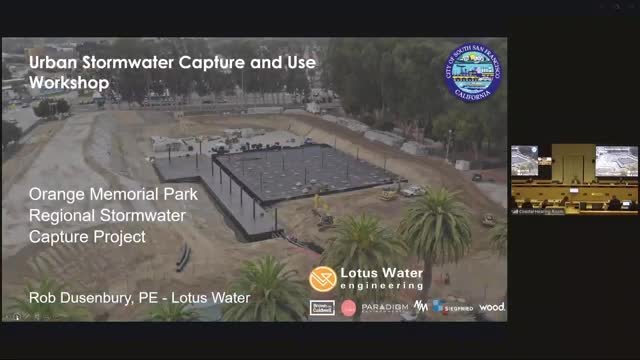
Summary
Engineers described Orange Memorial Park as a first‑of‑its‑kind regional stormwater capture project that stores stormwater in a cistern (≈230,000 gal) for reuse, directs overflow to a 1.6M‑gal infiltration gallery for groundwater recharge, and produces an estimated 15M gal/year of non‑potable reuse; ongoing O&M and permitting remain central implementation issues.
Rob Dusenberry of Lotus Water presented the Orange Memorial Park regional stormwater capture project, sponsored by the city of South San Francisco, as an example of a multi‑benefit approach that combines water quality treatment, reuse and groundwater recharge.
Dusenberry said the project diverts runoff from Colma Creek into a pretreatment structure (trash and grit chamber), then into a cistern with about 230,000 gallons of storage that can supply roughly three days of irrigation demand. When the cistern is full, water overflows into an infiltration gallery with about 1.6 million gallons of capacity for groundwater recharge. Treated water is also pumped into a water‑treatment building for final disinfection and irrigation use; the system is designed to provide about 15,000,000 gallons per year of non‑potable reuse and an estimated 80,000,000 gallons per year of recharge under certain conditions.
Dusenberry underscored that land availability drives siting decisions — parks and school grounds are frequently the only places large enough to host storage and treatment infrastructure — and stressed the importance of partnerships. Caltrans and local flood‑control stakeholders contributed funding and credits during design, and the city secured cooperative funding that brought the project to roughly $15.5 million to design and construct.
On operations, Dusenberry said the city has experienced O&M costs of around $300,000 a year and is exploring credit and cost‑sharing arrangements to ensure long‑term funding. He also recounted technical lessons: because the diversion draws from a concrete‑lined flood channel the system received significant bedload (muck) not originally anticipated, so the pretreatment sequence was adapted (trash rack placement and more frequent channel cleaning). The project initially experienced reliability problems with an ultrafiltration treatment skid using plastic cartridges; those housings were replaced with welded steel units and remote monitoring was improved, which increased uptime.
Permitting and monitoring were extensive. Dusenberry said the project obtained a Clean Water Act 401 certification, California Fish and Wildlife 1602 approval and a Corps nationwide permit. For reuse oversight, he said the county directed the city to regulate reuse locally; the project team runs four parallel monitoring programs — flow tracking, performance monitoring for PCBs/mercury/trash removal, environmental monitoring because infiltration occurs above a drinking‑water aquifer, and reuse system monitoring.
The long‑term sustainability question remains funding and credit frameworks for O&M. Dusenberry and board members discussed regional credit‑sharing approaches that helped launch the project and stressed that long‑term O&M funding and clear permitting pathways will determine whether similar projects can be scaled.
The board thanked the presenter and moved on to related agenda items and the next presenters.