State officials outline new ADU rules, how Nantucket should prepare
Loading...
Summary
State housing officials told a Nantucket audience that ADUs (the smaller of 900 sq ft or 50% of a principal dwelling) are now a protected use by right across single‑family zoning in the Commonwealth, advised towns on handling preexisting structures and short‑term rentals, and announced $5 million pilot incentives for FY26 and FY27.
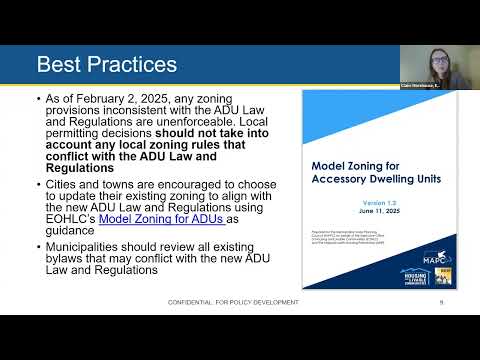
Claire Morehouse, accessory dwelling unit coordinator at the Executive Office of Housing and Livable Communities, told Nantucket officials and residents at a regional webinar that under the Affordable Homes Act "ADUs under 900 square feet are now by right in all single family zoning districts across the entire Commonwealth." The regulations were published by EOHLC and took full effect Feb. 2, Morehouse said.
The change makes ADUs a "protected use" under chapter 40A and the Dover‑Amendment legal framework, Morehouse said, and municipal bylaws must be reviewed for conflicts. "If a preexisting accessory dwelling unit that was permitted prior to the Affordable Homes Act meets the standards of a protected use ADU, any prior conditions...may not be continued," she said, referring to owner‑occupancy or familial restrictions commonly attached to older permits.
Roy Montoya, counsel with the EOHLC municipal unit, told participants that the statute applies to municipal ordinances and bylaws, not private homeowners associations. "An HOA would be a private agreement between homeowners and not forced by the municipality," Montoya said, meaning deed restrictions remain a private civil matter rather than a zone‑based statutory prohibition.
Officials urged towns to adopt or update local ADU bylaws using model zoning language EOHLC posted online, and to consult Attorney General municipal‑law decisions where conflicts arise. Morehouse noted EOHLC resources — FAQs, recorded webinars, and a municipal law lookup tool on AGO and MassGIS sites — and encouraged building officials to use those tools to resolve implementation questions.
Practical points for Nantucket surfaced repeatedly in the Q&A. Several participants asked how the change affects lots that already contain multiple secondary structures. Montoya said the statute grants the homeowner a right to one protected ADU that meets the technical definition (the smaller of 900 square feet or 50% of the principal dwelling); towns must administratively identify which existing structure, if any, qualifies. If the unit must be brought up to code to be occupied legally, the homeowner would need to apply for permits and an occupancy certificate.
The webinar clarified how local short‑term rental (STR) policies interact with the state rules. Morehouse said whether a protected‑use ADU may be used as an STR is a municipal choice: a town may adopt a bylaw to prohibit STRs in protected ADUs, but such restrictions would apply to the unit the town identifies as the protected ADU. Montoya warned that the interaction between preexisting STR use and the new protected‑use definition can raise nonconformity and legal questions, and advised town counsel review in complex cases.
Officials also discussed size and additional units. Montoya emphasized that the statutory ADU definition is a technical baseline (900 square feet or half the principal dwelling), and that municipalities can be more permissive by right; anything larger than the technical ADU definition is not, strictly speaking, an ADU under chapter 40A and may be governed differently. The statute also requires a special permit for "additional" ADUs beyond the protected single unit, so towns should be clear in local bylaws whether larger, special‑permit units are intended to be "protected" or treated as a discretionary allowance.
Morehouse described two new outreach initiatives: an ADU design challenge for architects launching in mid‑December and a pilot incentive program that will allocate $5,000,000 in fiscal year 2026 and $5,000,000 in fiscal year 2027 to subsidize predevelopment, development costs and technical assistance for ADU projects. She also said an early EOHLC survey of building officials showed about 550 ADUs approved during the first six months after the regulations took effect, roughly split between attached/interior and detached units; a year‑long survey will follow and results will be posted on mass.gov/adu.
Presenters flagged address standards (MassGIS) as a state priority: all ADUs must be assigned addresses so mail and emergency services can locate additional dwelling units, and MassGIS is adding building‑level pinpointing to improve emergency response and to enable the state to count ADUs in housing inventories.
Town officials on the call asked about historic‑district controls. Montoya said the regulations permit tying dimensional or design standards in historic districts to different local references than single‑family homes, but any restriction must survive the Dover reasonableness analysis and be justified as a legitimate municipal interest.
The session closed with EOHLC urging Nantucket to review local bylaws ahead of town meeting, to consult counsel where necessary, and to use state office hours and posted resources for follow‑up. "If you continue to have questions, please continue to stop by those," Morehouse said, and she provided contact information and links for further guidance.