Fort Myers Beach holds joint LPA/council review of proposed comprehensive plan; debates density, marinas and public‑benefit rules
Loading...
Summary
At a Nov. 25 joint meeting, Fort Myers Beach officials reviewed updates to the 2045 comprehensive plan. Debate centered on future land use rules — height metrics, marina density, accessory dwelling units and the definition of public benefits — and staff will return edits before a December vote.
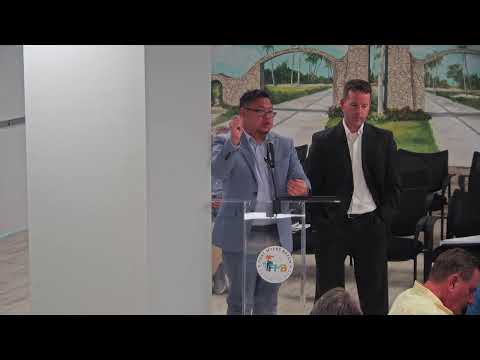
Fort Myers Beach’s town council and Local Planning Agency spent a marathon Nov. 25 session reviewing proposed changes to the town’s 2045 Comprehensive Plan, with the biggest fights centered on the future land use element.
Chair Saracita outlined the update’s history, noting the Cordino Group was hired “in the middle of COVID in June 2020” and that hurricane recovery and personnel turnover have complicated outreach. The council decided to take public comment by grouped elements and moved through the Vision, Future Land Use and other chapters in sequence.
Much of the formal debate focused on whether the document should use prescriptive language such as “shall” or softer language such as “should.” Several members argued restoring “shall” would preserve existing protections for residential neighborhoods; staff recommended restoring “shall” except where changing it would create internal conflicts the land development code must resolve.
Height and density drew sustained attention. Members proposed removing references to story counts and instead using an absolute height (30 feet) to reduce disputes about whether elevated ground‑floor levels count as a story. “If height is what you’re worried about, then let’s focus on the 30 feet,” a council member said during the discussion.
Marinas and waterfront policy produced perhaps the meeting’s most detailed technical argument. Staff reported earlier drafts had proposed allowing a small residential component for marinas (for example, 0.5 dwelling units per acre), but some council members worried that any open-ended allowance would expand development rights. Other members urged a modest, measurable cap to keep marinas economically viable. After extended discussion, several council members asked staff to return a measurable metric and potential caps (options discussed included a numerical cap such as 6 dwelling units per acre with a percentage cap on residential share) for review at the December hearing.
Council and staff also debated how to treat accessory dwelling units (ADUs). Staff cautioned that detailed standards — whether ADUs must be owner‑occupied or can be attached versus detached — are best placed in the land development code so they can be implemented consistently and remain compatible with state rules. Council members asked staff to prepare proposed code language to match any plan policy the council adopts.
A separate, contentious strand of discussion concerned how the plan should treat public benefits used to justify taller or denser projects. Multiple members urged clearer criteria — Jim Dunlap proposed that public benefits be “perpetual,” “accessible to or for the benefit of all,” and “unique in their nature or physical location” — while staff recommended that detailed scoring and implementation be handled by an implementing ordinance rather than locked into the comp plan.
Residents urged stronger environmental protections in public comment. Terry Kane asked that the plan preserve environmental critical areas and wetlands. Resident Kathy Schultz warned a draft change to Bowditch Point’s description — phrased as increased recreational accessibility in the draft — would amount to “a pretty significant shift” away from the preserve‑and‑quiet‑beach language in the current plan. Staff agreed to restore or reframe language to balance public access with habitat protection and to return specific text for council review.
The meeting closed with staff committing to prepare a change sheet that captures the edits discussed, circulate redlines and revised ordinance language for Monday’s meeting, and then submit the adopted plan to state review per statutory timelines. Staff told the council it would need roughly a week to assemble final materials after Monday’s meeting; state review and effective dates follow the statutory submission and objection windows.
The council scheduled continued review on Monday, Dec. 1, with staff returning clarified language on "shall/should," marina metrics, ADU/code crosswalks and public‑benefit guidance.