
Boulder pairs citywide elimination of parking minimums with a tiered TDM ordinance and financial guarantees
Get AI-powered insights, summaries, and transcripts
Sign Up Free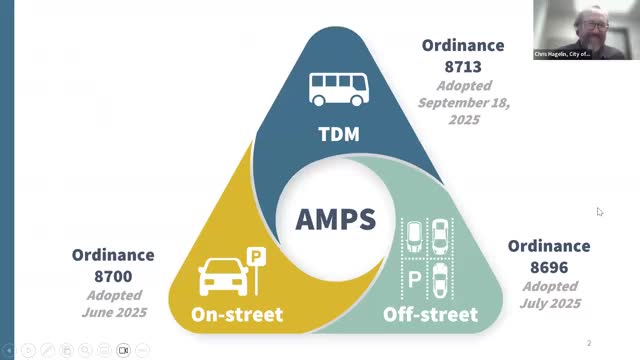
Summary
Boulder eliminated off‑street minimum parking requirements citywide and adopted a tiered Transportation Demand Management ordinance requiring annual financial guarantees, monitoring and trip‑reduction targets for larger developments.
Chris Hagelin, principal project manager/planner with the City of Boulder, described the city's AMPS (access management and parking strategies) program and three ordinance changes that together removed minimum off‑street parking citywide and added complementary on‑street controls and a new TDM ordinance for new development.
Boulder chose a citywide removal of minimums without adding parking maximums for off‑street spaces, and instead focused on on‑street programs (neighborhood parking permit programs, paid parking and visitor limits) to prevent spillover into residential areas. Hagelin said the city also revised bicycle parking design standards to accommodate larger and cargo bicycles.
To make the reduction in parking work, Boulder adopted a tiered TDM ordinance that applies to new floor area above set thresholds, offering package options (EcoPass‑plus, flexible transportation wallets, or custom approaches) and assigning annual financial guarantees paid by owners and held by the city. Hagelin said the city estimated annual program costs of about $200 per employee for smaller tier 1 commercial projects and about $350 per employee for larger tier 2 projects; residential projects would pay roughly $180 per unit (40–99 units) or $280 per unit (100+ units) to fund ongoing measures like EcoPasses and bike‑share memberships. Tier‑2 projects must meet a trip generation target of 30% below ITE rates, with monitoring and remedial funding if targets are missed.
Hagelin emphasized that effective TDM typically incurs ongoing costs, requires tenant/occupant participation and needs a monitoring regime to test and refine measures over time.