Get Full Government Meeting Transcripts, Videos, & Alerts Forever!
Get email alerts on the Inclusionary Zoning topic
No spam. Unsubscribe anytime.
Zoning hearing for Wesley Seminary focuses on $8M off‑site IZ offer and who should run it
Summary
At a Nov. 24 Zoning Commission hearing on Wesley Theological Seminary’s further processing (case 23‑08A), the debate centered on Landmark’s proposed 659‑bed student residence and Wesley’s $8,000,000 off‑site inclusionary‑zoning (IZ) contribution. ANC and community witnesses, and an independent valuation, said the amount is likely below the value needed to produce the minimum IZ units; DHCD proposed administering a Ward 3 fund and a homeownership pilot option.
The Zoning Commission on Nov. 24 heard several hours of testimony on Wesley Theological Seminary’s further processing application and Landmark Properties’ proposed university housing, but the hearing quickly focused on the project’s inclusionary‑zoning (IZ) commitment.
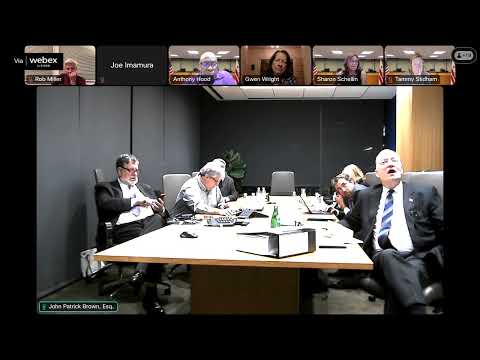
The applicant team told the commission it has proposed an $8,000,000 payment to satisfy the off‑site IZ obligation tied to the text amendment that allowed the university housing concept. "We have indicated an $8,000,000 contribution," said a member of the applicant team during the presentation (applicant representative Patrick Brown). The donation, the applicant said, derives from project budgeting and earlier design changes.
Opposition parties, ANC 3E and neighborhood groups, pressed that the figure is insufficient. Jonathan Bender, chair of ANC 3E, introduced a valuation prepared for the ANC and argued the fee should be higher. The ANC’s financial expert, Chris Adhikari, gave a written estimate in the hearing record that "the approximate value of inclusionary zoning at the proposed project falls between $9,900,000 and $15,100,000," a range that covers a 10%–15% IZ requirement.
At the hearing DHCD’s housing official, Art Rogers, said the District would accept funds for a Ward 3 program and proposed a different option: use the money to seed a homeownership pilot under the existing Home Purchase Assistance Program (HPAP). "DHCD would announce the availability of the $8,000,000 Ward 3 Fund," Rogers said, adding that DHCD’s preferred path would permit blending the contribution with other subsidies to create permanently affordable units.
ANC and community witnesses pressed for either a higher flat contribution (ANC asked the commission to consider a figure close to a 15% IZ equivalent) or for the money to be directed to community‑championed projects. ANC 3E and neighborhood groups proposed a nearby Somerset Development project they say could be advanced with roughly $10,000,000 of gap financing; Somerset testified it has a $9.77 million gap and could begin predevelopment in 2026 if funds are available.
Office of Planning supported approval of further processing generally but noted DHCD’s view that the District could be the administrator. Several neighborhood groups opposed DHCD as the recipient, citing recent audit reports and press accounts. LISC (Local Initiatives Support Corporation) had been discussed earlier in negotiations as an administrator; opponents and community groups urged that LISC or a locally governed vehicle should be considered to prioritize Ward‑3 outcomes.
The commission did not vote. Members asked the applicant, ANC and DHCD to supply detailed cost math and program rules, and set a schedule for supplemental filings: parties must submit further material by Dec. 8, the record will stay open for responses through Dec. 15, and the matter was calendared for deliberation on Dec. 18.
What’s next: the commission asked for itemized calculations showing how the applicant derived the $325–$358 per‑square‑foot construction proxy and for DHCD to explain how it would use the funds (rental, new construction, buy‑downs or homeownership). The hearing record now includes competing cost estimates and at least three administration options; the commission signaled it will weigh those before any final action.
(Reporting includes direct testimony and filings in ZC Case 23‑08A.)