
Laramie outlines strategy to add 4,000 housing units by 2030, flags infrastructure and affordability challenges
Get AI-powered insights, summaries, and transcripts
Subscribe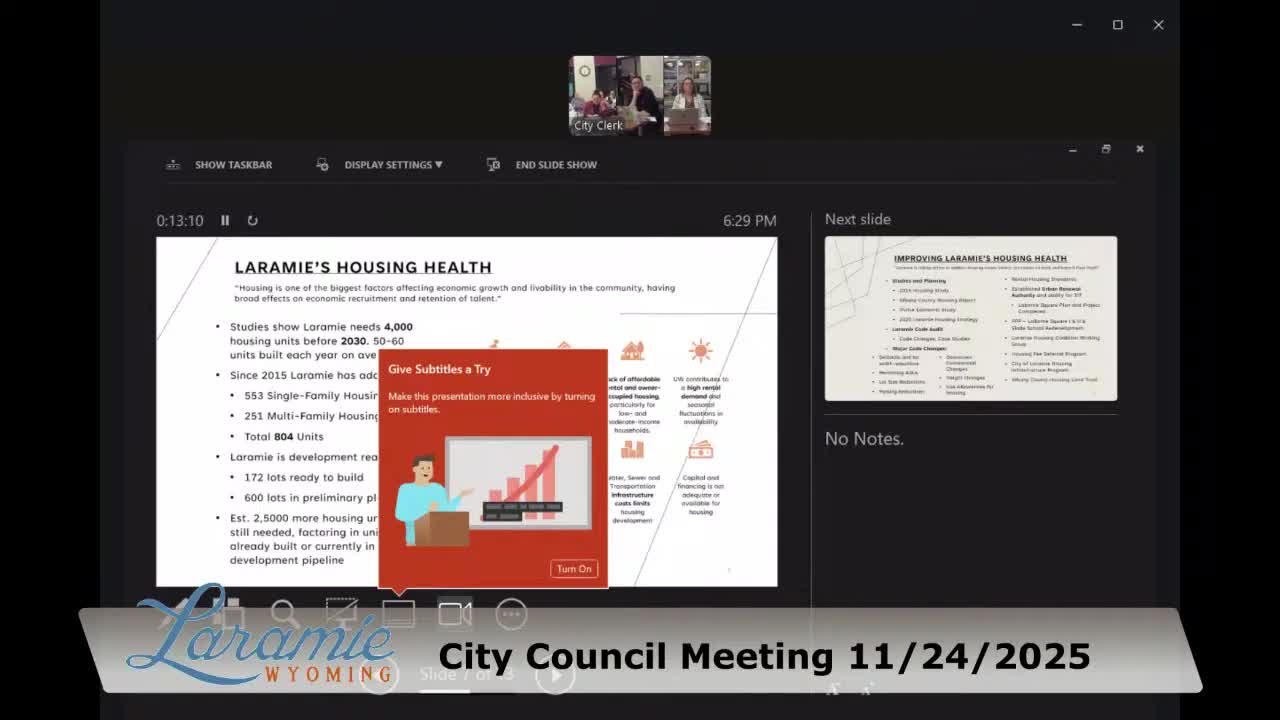
Summary
City planning and public works staff presented data showing a need for roughly 4,000 housing units by 2030 and described zoning changes, ADU allowances, an urban renewal project and a permit-fee deferral pilot intended to speed development while raising concerns about infrastructure costs and tenant protections.
LARAMIE, Wyo. — City planning staff on Nov. 24 told a joint roundtable with state legislators that Laramie faces a multi-year housing shortage and outlined local steps intended to accelerate production while managing costs and tenant protections.
Derek Taney, Laramie’s community development director, said a 2015 housing study — and updated state data referenced in the presentation — indicate the city needs roughly 4,000 new housing units by 2030, which averages to about 50–60 units per year but will vary depending on large multifamily projects. "We are behind," Taney said, summarizing why the city has pursued a mix of regulatory and programmatic tools to expand supply.
Local policy actions described:
- Zoning and code changes: Staff said the city revised residential zoning to reduce setbacks, allow accessory dwelling units (ADUs) in single-family districts and reduce parking and lot-size requirements to enable more dense infill and multifamily development.
- Urban renewal and catalytic sites: The city designated an urban renewal area around a former public works site on 4th Street; staff said they hope a public-private partnership will produce multifamily housing there.
- Permit-fee deferral pilot: The city launched a program to defer permit fees for certain large projects so developers do not have to carry those upfront costs through construction, a measure staff said is intended to reduce early carrying costs and catalyze projects.
- Housing land trust and financing tools: Staff described a newly formed county housing land trust and highlighted state programs (e.g., Wyoming Business Council infrastructure funding) and a proposed state housing investment bill as potential financing sources.
Infrastructure and affordability concerns: Bruce Webb, public works director, described recent capital projects meant to provide capacity for growth, including a recently completed north water storage tank and upsized sewer mains; he said the wastewater plant upgrades and water storage work were designed with future development in mind. Staff and legislators repeatedly noted that infrastructure costs and franchise utility extensions remain barriers; a staff-cited contractor estimate suggested construction costs have risen substantially in recent years.
Tenant protection issues surfaced in discussion of mobile home parks. Councilors warned that stricter park standards can lead to higher owner costs and rent increases that risk displacing long-term tenants; staff said code adjustments will aim for incremental safety improvements without forcing mass displacement.
What's next: Staff asked legislators to coordinate on potential state funding and technical assistance and said the city will continue to refine code and financing tools. Legislators offered to work with the city on a housing investment bill and encouraged staff to provide bill-ready materials for the legislative process.
The presentation concluded with a round of questions; no formal local action was taken at the meeting.