
Laramie leaders press Wyoming lawmakers on tax-shift options, warn of local impacts
Get AI-powered insights, summaries, and transcripts
Subscribe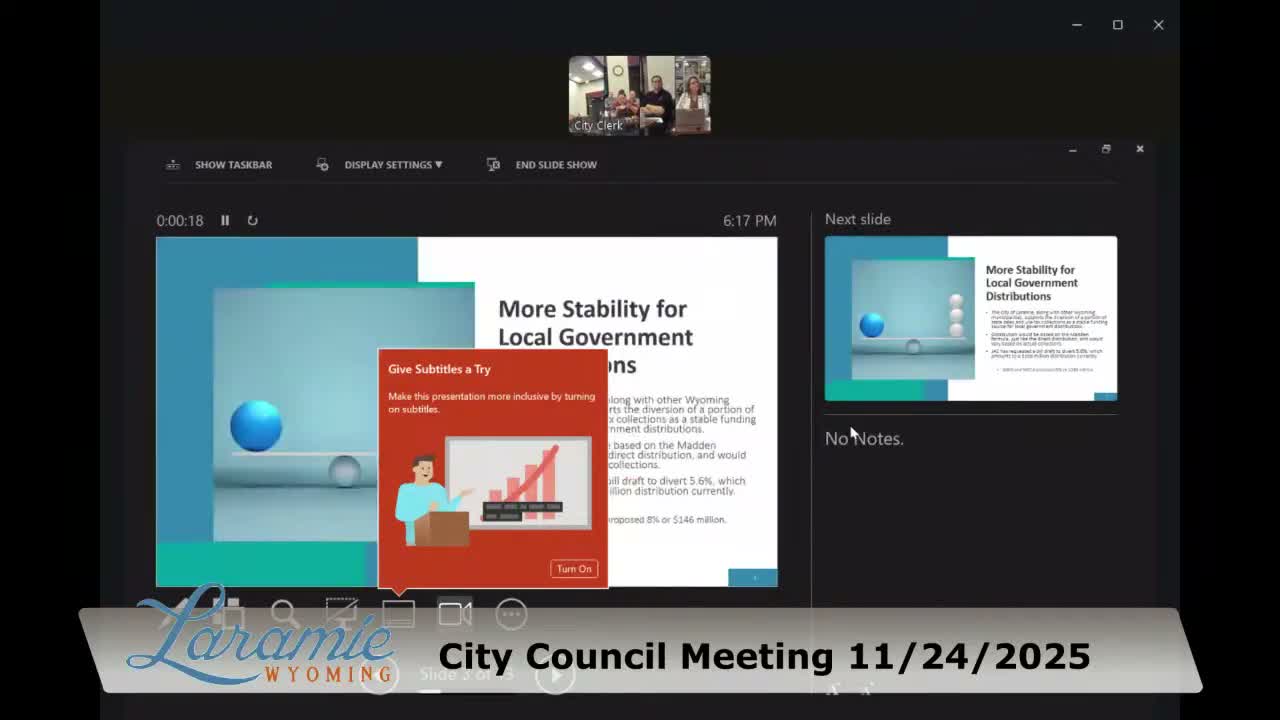
Summary
City financial staff briefed state legislators Nov. 24 on proposals to stabilize local government distributions — including a draft to divert a fixed share of state sales and use taxes — and stressed potential trade-offs for Laramie residents, infrastructure and local option taxes.
LARAMIE, Wyo. — City finance officials and Laramie City Council members met with Albany County and state legislators on Nov. 24 to outline how competing state proposals to change local government funding could affect the city’s budget, services and residents.
Ben Wade, Laramie’s administrative services director and chief financial officer, told the roundtable the Legislature is considering two approaches to stabilizing local government distributions: a standalone direct-distribution appropriation and a change to the sales-and-use-tax distribution formula. Staff described a working draft that would return about 5.6% of state sales and use tax collections to local governments; local associations had sought an 8% return. Wade said the 5.6% draft was being discussed as a means to create a more stable, formula-based distribution than relying on mineral/severance over-cap receipts.
"We support the diversion of a portion of state sales and use tax collections as a stable funding source for local government distributions," Wade said, adding that Laramie has managed one-time mineral and wind-related collections as nonrecurring revenue rather than budgeting them for ongoing services.
Why it matters: The city emphasized the difference between recurring revenue and one-time collections. Wade and other staff explained that Laramie budgets conservatively (using historic collection levels as a baseline) so that operating services are not cut when volatile receipts decline. Several legislators warned that the distribution method matters for equity: shifting the tax base can produce winners and losers among Wyoming communities.
Legislators pressed staff for specifics. Representatives and senators noted two “horses in the race”: maintaining a direct-distribution appropriation (previously around $146,000,000 statewide) or diverting a fixed percentage of sales tax collections (the committee draft at the time of the meeting was 5.6%). Senator Rafas (one legislator in the discussion) underscored that formulas such as the “Madden” distribution affect hardship adjustments that channel more money to lower-revenue communities; staff acknowledged that changing the base without preserving hardship provisions could reduce aid for counties like Albany.
Concerns about regressivity surfaced in the discussion: some attendees cautioned that replacing property tax revenue with increased reliance on sales taxes could shift burdens onto renters and low-income households. One city councilor said Laramie has a higher share of renters and lower-income residents who could be disproportionately affected by sales-tax–based funding.
City asks and next steps: City staff asked legislators for support providing stable revenue and for help communicating changes to voters if any local-option taxes are affected. Legislators requested one-page data briefs and spreadsheets from Laramie staff to inform committee debates and said they would be available for follow-up during the upcoming budget session. Several legislators outlined the procedural calendar for the budget session and suggested the city consider budget amendments or bill language where appropriate.
The roundtable ended with no formal action; staff said they would continue to supply data and coordinate with the delegation as the two funding proposals move through committees.