
Lacey staff lay out 2026 state priorities, seeking academy funding and help on public-defense costs
Get AI-powered insights, summaries, and transcripts
Subscribe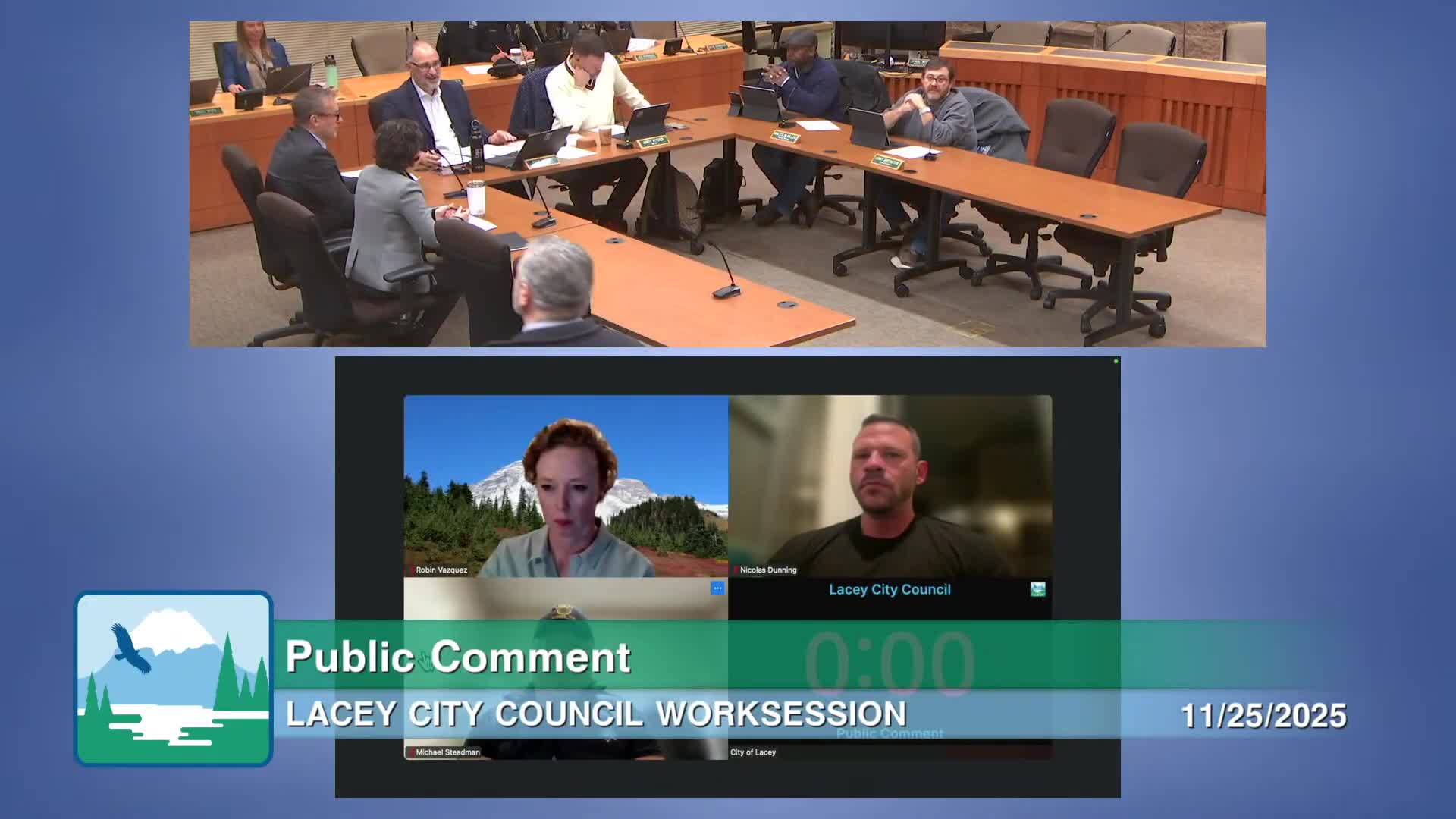
Summary
At a Nov. 25 work session, Lacey staff presented a streamlined 2026 state legislative agenda that includes $1 million annually to run a regional law-enforcement academy at the Lacey training center, a funding mechanism for animal control, extension of an annexation sales-tax credit and requests to address new public-defense standards.
Lacey officials presented the city's 2026 state legislative agenda at a Nov. 25 work session, asking the Legislature to set aside $1 million annually to operate a regional law-enforcement academy at the Lacey training center and to help cities respond to new public-defense caseload standards.
Shannon Bridal, who led the staff presentation, said the city streamlined its agenda to three top priorities and several supporting items, and that the city's policy manual now includes language to protect local funding and to request flexibility for municipalities. "We have, the Thurston County Regional Basic Law Enforcement Academy at the Lacey Regional Training Center" is listed as a priority, she said, noting that the request is for operating support, not capital costs.
Brian Enslow, who briefed the council on the state political environment, said the short 60-day session will likely bring repeated housing and revenue debates and flagged the financial pressure created by recent caseload and public-defense standards. "The overall picture is not a lot has changed last year," Enslow said, noting both continuing tensions between branches and the need to plan for grant and operating shifts.
Council discussion focused on several concrete proposals. For the regional academy, staff said the existing training facility is purpose-built and that an operating allocation would ease training capacity constraints in the region and boost local recruitment of officers and trainers. For animal control and sheltering, staff said they are working with a statewide stakeholder group and Representative Parsley to develop one of several possible funding mechanisms (property tax, sales tax, household fee or REIT-style approach); that proposal previously appeared as HB 1985 in the Legislature.
The council and staff debated an extension of the annexation sales-tax credit (which currently expires in 2028). Staff recommended adding time so jurisdictions can build the interlocal agreements and supporting tools necessary to make large annexations feasible; some council members warned a long extension could reduce urgency for action and urged pairing an extension with incentives to encourage near-term movement.
Public-defense standards prompted the most urgent Q&A. One council member warned, "this is the thing that's gonna bankrupt cities," arguing the new caseload standards will substantially increase a city's need for public defenders and the related costs. Staff said Lacey estimates the standards could require hiring several additional public defenders and projected roughly $4 million in additional costs over a 10-year horizon without state support. Enslow and Bridal urged coordination with the legislature, the courts and regional partners on phased implementation and additional funding.
Staff also asked whether the council wanted to include statements of support for regional partners' legislative priorities (Association of Washington Cities, Thurston County shared agenda, regional housing council); councilmembers indicated assent. At the start of the session the council had approved the agenda unanimously.
Next steps: staff will finalize the legislative policy manual language and continue stakeholder meetings; the city expects to socialize these priorities with local legislators and partner jurisdictions as the short 2026 session approaches.