
Chelsea city manager urges commercial and Broadway-area growth to offset projected school-aid losses
Get AI-powered insights, summaries, and transcripts
Subscribe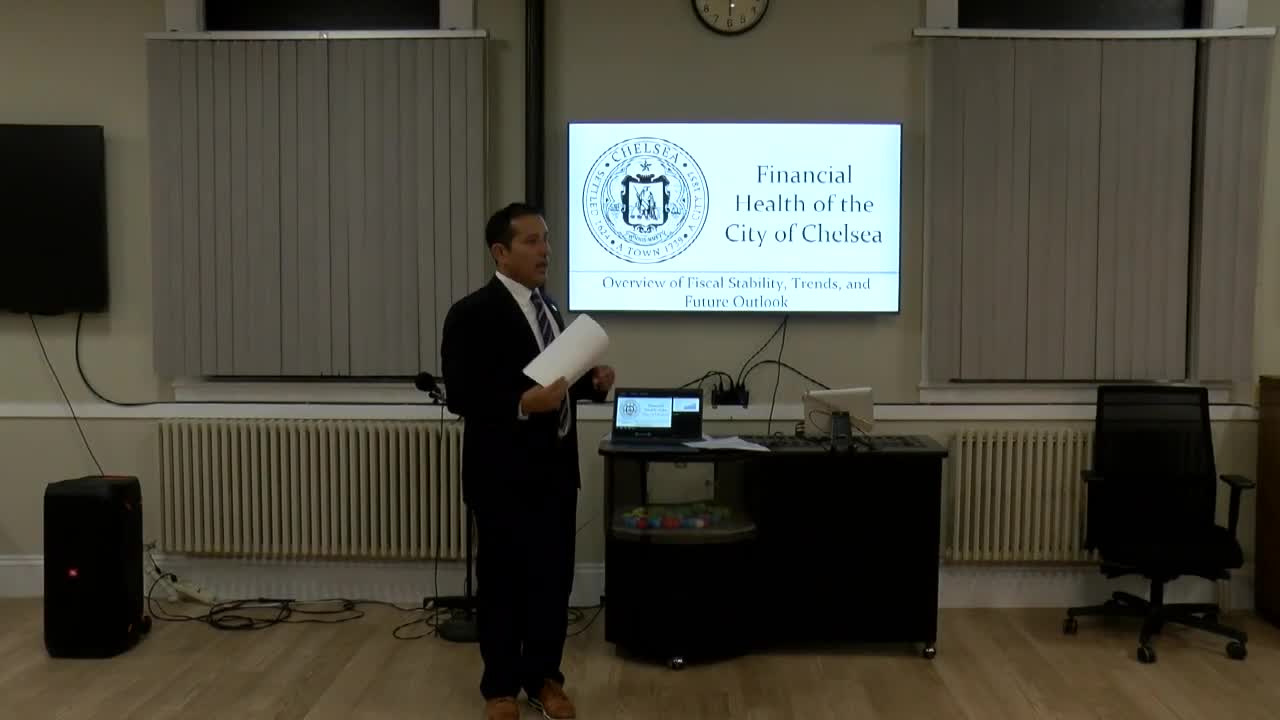
Summary
City presenter said Chelsea must pursue new growth — commercial development, Broadway projects and select conversions of city property to private tax rolls — to offset limits from Proposition 2½ and a projected drop in Chapter 70 school aid tied to falling enrollment.
Speaker 1, the city manager, told a standing-room audience that Chelsea must rely on new growth to preserve services and avoid painful cuts as the city faces fiscal pressure from state aid declines and rising costs.
The presentation laid out why Proposition 2½—s 2.5% annual levy limit constrains local revenue and how new growth (new construction, subdivisions and returning tax-exempt properties to the tax roll) and one-time permit fees can expand the city—s capacity. "New growth is good," Speaker 1 said repeatedly, noting a 2022 spike tied to a large Everett Avenue project (referred to in the presentation as the Farrow building) that added roughly $200,000,000 in assessed value to Chelsea.
Why it matters: Speaker 1 warned the city is vulnerable because it depends heavily on Chapter 70 state aid for its schools, and enrollment fell sharply. "When enrollment goes down by 340 kids in one year, it's going to directly result in a huge reduction in state aid," Speaker 1 said, estimating a potential shortfall of about $6 million. At the same time, major cost drivers such as health insurance have grown substantially: the presenter said health insurance costs rose by nearly $3 million over three years and stated "This year is going up 16%."
Key facts and numbers: the assessor, Jim (Speaker 5), reported the residential tax rate at about $11.38 per $1,000 of assessed value and the commercial rate at about $23.79 per $1,000 for the current year. The presenter described the conversion of 440 Broadway (the former Salvation Army building) to taxable condominiums as an example of returning city-owned property to the tax roll, and noted Chelsea has used tax-incentive financing rarely in recent years (one long-term TIF at 180 Central Ave and an earlier large TIF for a major project were mentioned).
Policy options and local trade-offs highlighted in the talk included: pursuing commercial development for a higher "bank for the buck" return on the levy, selective use of TIFs or other incentives, and relying on one-time fees (building permits, infiltration/inflow fees) to support inspections and DPW investments. The presenter stressed the difference between levy revenue (ongoing) and one-time receipts (nonrecurring): "Those fees are not meant to be self-sustained," Speaker 1 said, explaining large project permits produce one-time resources but cannot replace steady tax capacity.
Community and next steps: Speaker 1 urged residents to attend hearings and public meetings in support of targeted projects, identifying Broadway, the Market Basket area and Park & Pearl as priority corridors for growth. On developer relations, the presenter said certainty is critical: "What I hear from developers is they want certainty," Speaker 1 said, adding the city must restore investor trust through predictable processes and community engagement.
The meeting closed with an invitation to future sessions: Speaker 1 said the city will hold a total of four budget conversations before the budget adoption in June. No formal vote or action was taken at the presentation; the session was informational and intended to solicit feedback and public support for development that could increase the city—s tax base.