
Commission discusses emergency response benchmarks, volunteer incentives and infrastructure needs
Get AI-powered insights, summaries, and transcripts
Subscribe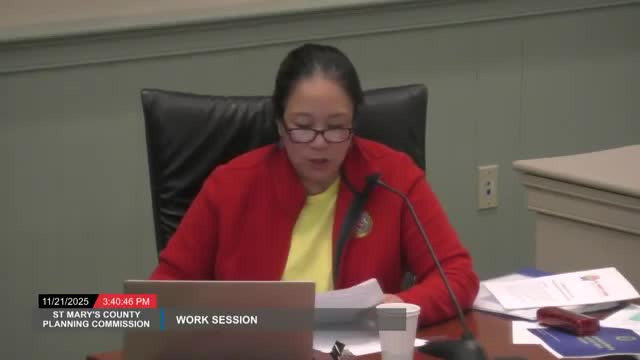
Summary
During the work session, emergency-services and sheriff—s office staff told the Planning Commission they track response times and that national benchmarks for fire/EMS response are around eight minutes; commissioners discussed volunteer recruitment, recent county volunteer incentives and the need for water-supply tanks and technology investments to support countywide public-safety coverage.
St. Mary's County emergency-services and law-enforcement officials briefed the Planning Commission on public-safety policies in the Comprehensive Plan 2050 draft, emphasizing realistic response-time metrics, volunteer recruitment strategies and infrastructure that supports fire and rescue operations.
Captain Steven Simons of the Sheriff—s Office cautioned against adopting unrealistically short response-time targets that do not reflect the county—s geography and travel times. The draft—s earlier crosswalk to the 2010 plan included a six-minute example and a reference to 4—.5 minutes; Simons said such numbers may not be achievable in more remote areas.
Jennifer Utz, acting director of Emergency Services, said fire and EMS nationally aim for roughly eight-minute response times and that the county tracks and trends response performance monthly, noting that peak demand hours (roughly 8 a.m. to 10 p.m.) and resource saturation influence achievable times. She also described longer transport times when patients require out-of-county trauma centers and how such transports tie up county resources.
Commissioners asked how the county supports volunteer fire and rescue companies given national volunteer declines. Utz listed retention and recruitment tools: a LOSAP (length-of-service award) program, a county volunteer incentive program (property-tax incentives or stipends tied to performance thresholds), dependent-care reimbursements for volunteers and free training via the Maryland Fire Rescue Institute. Staff also noted an ongoing county capital program to install large water-supply tanks (30,000+ gallons) in areas without hydrants to support tanker operations.
The meeting also touched on investments in shared public-safety technology (dispatch, tablets, body cameras) and the role of county IT. Captain Simons noted many systems are now cloud-based and that sheriff—s technology is often interoperable with county IT systems. A commissioner suggested broadening the draft—s "invest in law-enforcement technology" language to cover public-safety technology more generally.
Staff agreed to clarify response-time language, to cross-reference CIP investments (water tanks) and to consider broader phrasing for technology investment and volunteer-support actions in later drafts.