Wisconsin Arts Board panel reviews 11 Creation & Presentation grant applications; accessibility responses absent
Summary
An advisory panel for the Wisconsin Arts Board reviewed 11 Creation & Presentation grant applications, praising several programs while flagging that none of the applicants completed the new accessibility self‑assessment required for state‑funded organizations. Panel recommendations will go to the full board for a December vote.
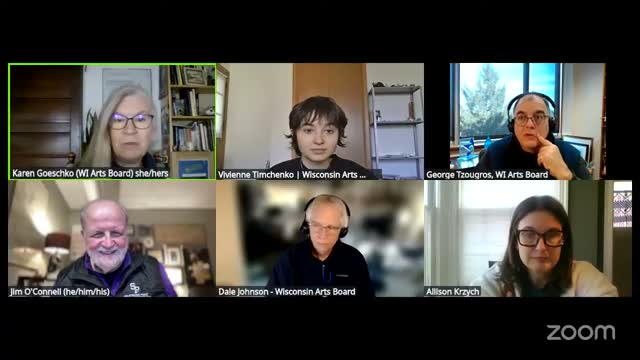
Lashandra Vernon, chair of the advisory panel and a member of the Wisconsin Arts Board, convened a remote review on behalf of the Arts Board to evaluate 11 Creation & Presentation grant applications from organizations across the state.
Panelists and staff ran the applications through the board’s four review criteria — artistic/educational/cultural value; organizational and financial management; community participation and accessibility; and planning, evaluation and documentation — and assigned individual scores on a 1–100 scale that staff will average and forward to the full board.
"Applicants will be notified of grant decisions by mid December," Vernon said during the meeting. The chair also reminded panelists of the conflict‑of‑interest and appeals procedures and that staff would convert panel recommendations into the board’s December agenda.
A notable procedural issue emerged when panelist Jim O’Connell pointed out that none of the 11 applicants had confirmed completion of the Arts Board’s new accessibility self‑assessment. "None of the applicants responded to that question," O’Connell said. Staff told panelists they would follow up with applicants to secure the required confirmations and advised reviewers not to alter scores based solely on the missing checkbox.
Panelists praised multiple applicants for program quality and community reach. Highlights included Evergreen Theatre (Green Bay) for extensive youth programming and plans to adapt a former school into a community arts center; Sculpture Milwaukee (Milwaukee) for a citywide public sculpture program with local fabrication and a new tranche‑based sustainability model; Madison Contemporary Dance for bilingual education materials, a daycare‑linked model and strong survey‑driven adaptations; and Pablo Center at the Confluence (Eau Claire) for a large, multi‑venue presenting operation with an ambitious education slate but noteworthy post‑COVID deficits.
Reviewers raised similar questions across organizations: several applicants operating or expanding in owned or long‑term facilities face ongoing overhead pressures, and organizations with recent leadership or budget volatility were asked to clarify financial narratives and provide clearer evaluation metrics. Panelists applauded best practices such as bilingual 'how‑to' teaching materials and consistent audience surveys.
Panel procedure: each panelist will submit individual scores and comments; staff will average scores and prepare a recommendation packet for the Arts Board. Staff also reiterated that applicants scoring below 50 are automatically taken out of consideration for funding this cycle, and that staff will confirm missing administrative items (for example, UEI numbers and the accessibility confirmation) before any award checks are issued.
The panel ended with staff sharing a ranked score sheet and a brief discussion of sector trends — especially the fiscal challenges of building‑based organizations and the value of partnership models that reduce overhead for smaller groups — before closing. Chair Vernon will report the panel’s recommendations to the full Wisconsin Arts Board at its December 12 meeting; applicants are expected to learn final decisions by mid‑December. The session was recorded and live streamed.
Reporting note: quotes and factual details are drawn from the panel meeting transcript and attributions are limited to speakers who identified themselves during the session.