Get Full Government Meeting Transcripts, Videos, & Alerts Forever!
Get email alerts on the Surveillance License Plate Readers topic
No spam. Unsubscribe anytime.
South Lyon council approves Road Commission agreement allowing license‑plate readers on county roads
Summary
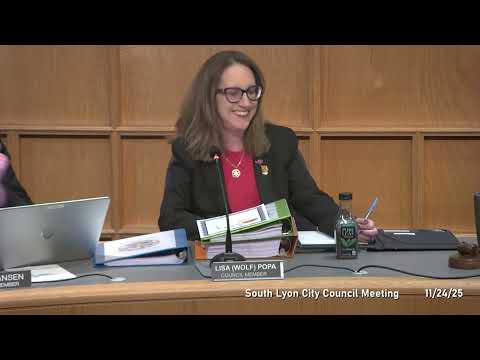
The South Lyon City Council voted to approve an agreement with the Road Commission of Oakland County permitting license‑plate reader cameras on county‑maintained roads in the city. Council members debated privacy, access logging and oversight before the measure passed by recorded roll call.
The South Lyon City Council voted to approve an agreement with the Road Commission of Oakland County to allow installation of license‑plate reader cameras on county‑maintained roads within the city.
Supporters framed the measure as a law‑enforcement tool. Council member Kurzweil moved to approve the Road Commission agreement; after roll call the motion carried with a majority of council members voting yes. The final roll call recorded in the transcript lists Bogart voting no; Kurzweil (recorded as “Hertzweil”) yes; Dillg/Dilg yes; Squires no; HOPA/Hopa yes; Hansen yes; and Kennedy yes. The mayor declared the motion carried and the agreement approved.
Privacy and oversight concerns surfaced during debate. Council member Bogart cautioned that while Flock, the private company providing the cameras, images what is in public view—"It's what everybody else sees. It's a car, license plate, whatever"—the proposal raises the risk of warrantless tracking of vehicles. Bogart told colleagues: "As I had mentioned earlier, it requires a warrant to put a tracking device on a vehicle. We're giving warrantless ability to track vehicles. Flock is a private company. It's a private database. There's no oversight by any government entity whatsoever."
Council members asked staff to provide policy details if the agreement moved forward. Council member Kurzweil requested that counsel and department staff provide the council with procedures governing access to captured images and any logs showing who viewed them. An unidentified staff member responded, "We will have a policy, and I'll make sure council has it," and said they would research whether the system creates an audit trail showing who accessed photos.
The council's approval follows two procedural votes: an initial motion to deny the Road Commission agreement was introduced (mover: Council member Bogart; seconder: Council member Dilg), but council members later reverted to the original language and reintroduced a motion to approve, which ultimately carried.
Next steps in the transcript were limited to the agreed deliverable that staff would prepare a written policy and provide it to council. The transcript does not specify the text of the Road Commission agreement, any contract terms with the vendor Flock, a timetable for installation, or whether any county approvals beyond the Road Commission are required.
Action taken: motion to approve the Road Commission agreement (mover: Council member Kurzweil; second: recorded support). Final roll call as recorded in the meeting transcript resulted in a majority yes vote and the motion carried.
What remains unclear from the transcript: the precise audit/logging capabilities of the vendor system, the exact language of the agreement approved, and whether the council or another government entity will have ongoing oversight of the vendor's private database.