Get AI Briefings, Transcripts & Alerts on Local & National Government Meetings — Forever.
PURA hearing presses Charter and Cox on billing, disconnection and in‑home contractor safeguards
Loading...
Summary
At Nov. 21 PURA evidentiary hearings on the Charter–Cox transaction, regulators and the Office of Consumer Counsel pressed applicants on billing statements, proration, procedures to prevent disconnection during disputes, contractor background checks, training and senior discounts; companies agreed to late‑file detailed exhibits.
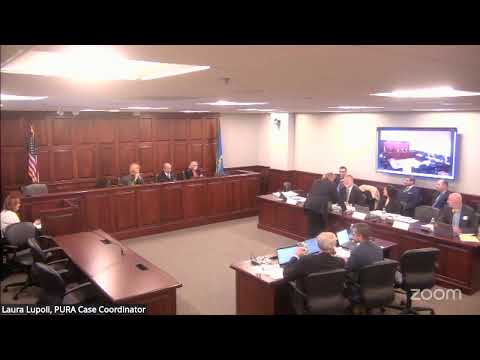
Commissioner Holly Cheeseman presided over day two of Public Utilities Regulatory Authority (PURA) evidentiary hearings on Nov. 21 in docket 25‑0811, directing detailed questioning of Charter and Cox about consumer protections embedded in the proposed merger.
The Office of Consumer Counsel (OCC) focused early on whether customers receive clear billing notices and protections against disconnection while a bill is disputed. Rianna Ash, OCC telecom policy adviser, asked whether accounts can be flagged to prevent disconnection during a pending dispute and whether customers receive an acknowledgment. Charter’s customer‑service witness said agents are available “24 by 7, 365 days a year” and that escalated complaints receive a formal acknowledgment; the company said account flags can prevent disconnection where state requirements apply.
The panel also questioned the sample Connecticut bill used in Charter’s filing, noting language that a bill “does not provide credits for monthly subscription services that are canceled prior to the end of the current billing month.” Charter acknowledged that the sample bill identifies the “Connecticut Public Utilities Regulatory Authority” as the franchise administrator and said its practice is to comply with Connecticut’s proration law for video services; the company said it would correct billing language if it is misleading.
On in‑home safety, OCC asked whether personnel who enter consumers’ residences receive background checks and whether outside contractors receive equivalent screening. Charter testified that employees are background‑checked and trained for in‑home interactions and that contractor screening is required; the company agreed to file a late‑filed exhibit with details about contractor background checks and the training employees and contractors receive.
Charter witness Grama Kim also disclosed a correction to an interrogatory: “Upon further review of 1 of our responses to OCC 65, we discovered a calculation error” affecting average internal call transfer data for 2023–2024, and pledged to file an updated response that the company said reflects improved internal transfer rates.
OCC pressed whether current Cox cable tiers would remain available to existing customers post‑transaction. A Cox representative said existing customers can keep their services if they choose — colloquially described during the hearing as “grandfathering” — while both companies said they do not expect to continue offering those legacy packages to new customers. On senior and other franchise‑area discounts, witnesses said such discounts are rare in Connecticut franchise agreements and that where they exist they are usually tied to legacy franchise obligations; the companies agreed to supply state‑level summaries as late exhibits.
The commission directed the companies to file Connecticut‑specific first‑call resolution and other performance metrics that currently exist in the confidential record, and ordered late‑filed exhibits on contractor screening/training, sample bills, and billing error histories affecting 50 or more Connecticut customers. The hearing record will include those filings for PURA’s consideration of whether the transaction meets statutory public‑interest criteria.
The hearing recessed for lunch and reconvened later in the day; no final decision was reached.