
Planning commission reviews environmental chapter of St. Mary's 2050 plan, asks for clearer implementation and mapping
Get AI-powered insights, summaries, and transcripts
Subscribe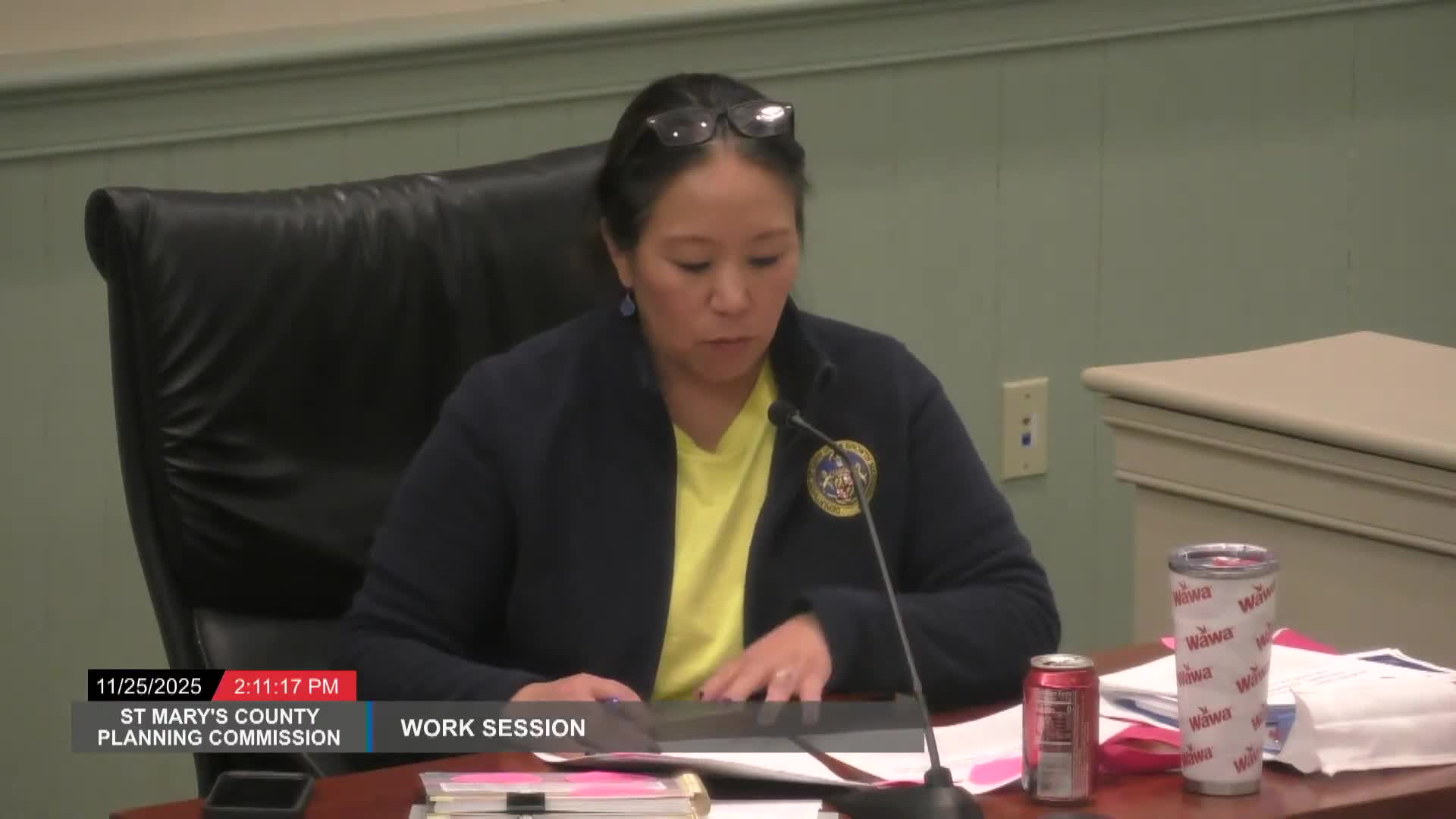
Summary
At its Nov. 25 work session, the St. Mary's County Planning Commission reviewed the environmental and natural resources chapter of the St. Mary's 2050 plan, pressing staff to clarify implementation language for buffer protections, to provide GIS-backed mapping for priority preservation areas and to soften new 'require' language to 'explore' in some action items.
St. Mary's County Planning Commission members on Nov. 25 reviewed the environmental and natural resources chapter of the St. Mary's 2050 comprehensive-plan update, pressing staff for clearer implementation language and better public-facing mapping.
Jessica, director of the county Department of Land Use and Growth Management, said the section is organized around areas of critical state concern, priority preservation areas and water resources and that much of the text carries forward from the 2010 plan while incorporating community input. "A lot of this stuff is already part of what our department does," she told the commission.
Commissioners focused questions on three practical topics: whether state-designated "targeted ecological areas" are mapped, how the plan treats farmland and preservation acreage, and whether proposed buffer protections would require a formal alternatives-analysis step for property owners.
Planner Stacy Clements said the targeted ecological areas are "a state mapped entity. We can access them through their GIS website," and staff confirmed those layers (wetlands, streams, slopes, soils and FEMA flood maps) are available in the county GIS and are being made more accessible on the county website.
On farming, commissioners asked whether the packet's priority-preservation acreage figure represented active farmland. Staff said exact active-farm acreage was not in the packet and that Economic Development would provide more complete maps and counts at the December meeting.
A contentious point was new action text that would ask for a "feasible alternatives analysis" before any buffer disturbance. Several commissioners worried that the word "require" could impose burdens on homeowners and small property owners; one said the language should be reframed to make the process lighter. IRG, a consultant on the plan, said the intent is "to give the option to incorporate that best practice" and that the county could calibrate the process locally. Staff agreed to prepare revised wording and to add subtext or examples describing what such an analysis might include.
The commission also discussed action 3.305, which would prioritize native buffers in headwaters and focus restoration "further upstream" rather than limiting policy to downstream protection. Commissioners asked for more explicit implementation steps and for any new language to be cross-referenced with the zoning or ordinance text where appropriate.
Why it matters: the section frames conservation and development decisions across St. Mary's County. Commissioners sought to balance environmental protection with predictability and cost for landowners, and they asked staff to return with clearer, actionable language and accessible GIS tools.
The commission set no formal motions or votes on the environmental chapter; staff said they would bring revised language, mapping clarifications and cross-references to ordinance/code sections back to the commission in a future packet.