
Cobb County creates stormwater utility, approves $4.75 monthly fee after heated public hearing
Get AI-powered insights, summaries, and transcripts
Subscribe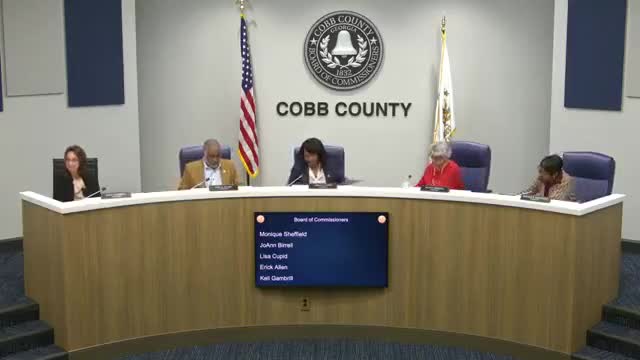
Summary
After more than five hours of public testimony and technical discussion, the Cobb County Board of Commissioners voted 3–2 on Nov. 20 to establish a stormwater utility and set a $4.75-per-equivalent-residential-unit monthly fee, while adopting a credit manual and some related code changes.
A divided Cobb County Board of Commissioners voted 3–2 on Nov. 20 to establish a stormwater utility and set a $4.75 monthly fee per equivalent residential unit (ERU), a measure County water officials said is needed to fund stormwater maintenance, pipe repairs and future regional projects.
The vote capped a public hearing that ran more than three hours and included dozens of residents who described flood damage, costly culvert repairs and sinkholes. Many urged the county to map its infrastructure, produce a master stormwater plan and hold off on any fee until those steps were complete.
Judy Jones, director of the Cobb County Water System, told commissioners the fee was built on the utility’s current $9.2 million budget and an analysis of impervious surface across unincorporated Cobb and the City of Mableton. Jones said staff modeled a set of incremental service additions — from adding inspection and repair capacity to funding future regional projects — that together justify the $4.75 ERU proposal. The county’s ERU was defined in the ordinance as 3,700 square feet of impervious surface; a single ERU equates to $4.75 a month for residential customers.
Jones said the water system used an outside vendor to map impervious surface and internal staff to align estimated annual costs with that surface area. She also told the board the proposed code would segregate stormwater revenue into an enterprise fund so those funds could not be transferred out to the general fund, a concern several speakers raised as a reason to distrust the county’s stewardship of dedicated dollars.
Opponents repeatedly called the proposed fee a “rain tax” and criticized past transfers of water-department revenue to the general fund. Several residents recounted large, out-of-pocket repair bills; one speaker said neighbors paid about $96,000 to replace a culvert after a 2021 storm and face ongoing sinkhole repairs. Residents also cited apparent gaps in the county’s inventory of stormwater assets and asked that the county finish mapping and a comprehensive plan before charging a new fee.
Supporters — including business groups and some residents — said Cobb’s stormwater backlog will not be addressed without a stable funding source. Matt Yarbrough of the Council for Quality Growth urged the board to move forward with reforms and to handle lift-station policy carefully; the Cobb Chamber representative said commercial properties will be major contributors and asked for an implementation timeline that allows businesses to budget.
Commissioners adopted the stormwater credit manual that will let property owners earn fee reductions for qualifying practices, and they set the fee structure to replace current stormwater charges embedded in water bills rather than adding on top of them. After final adoption the board set the fee to become effective June 1, 2026, and authorized the credit manual for the same date.
The measure passed 3–2, with Commissioners Burrell and Gamble recorded in opposition. The board recorded a number of companion code edits related to maintenance, nuisances and assessment districts at the meeting as part of the same package. The most recently adopted ordinance language and the administrative dates are expected to be posted to the County website and the Water System’s notice pages.
The ordinance does not promise immediate elimination of flooding or failing pipes; the county will still need to inventory private versus public responsibilities, prioritize repairs, and implement the credit manual. Jones said staff will start work on the prioritized items included in the financial model and that the enterprise structure is meant to keep revenues dedicated to stormwater work and to enable increased inspections and contracted repairs over time.
The next administrative steps are final ordinance publication, posting of the credit application and appeals procedures, and continued community outreach on how credits, exemptions and appeals will be handled.