
CFR CEO: Most family homelessness in Cobb County is situational; short-term housing and court partnerships help families stabilize
Get AI-powered insights, summaries, and transcripts
Subscribe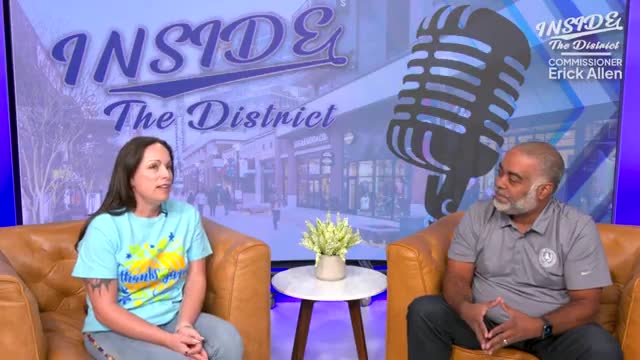
Summary
Melanie Keegan, CEO of the Center for Family Resources, told Commissioner Eric Allen most family homelessness in Cobb County stems from situational crises, not chronic vices, and described CFR’s short-term housing, employment partnerships and a housing stability court that pull families out of active eviction cases.
Melanie Keegan, chief executive officer of the Center for Family Resources in Marietta, said most family homelessness in Cobb County results from situational crises — job loss, illness or family breakup — and described how her nonprofit helps families regain stability.
Keegan spoke on the podcast Inside the District with Cobb County Commissioner Eric Allen and said CFR combines short-term housing, individualized case management and employment partnerships to move families from crisis to stable housing. "I think usually the biggest misunderstanding is that it came from a slew of bad choices…what we have found is that that is actually usually not the case," Keegan said.
Why it matters: Keegan said the county has "close to 2,700" students who meet the McKinney-Vento definition of homelessness — a figure she described as among the highest in the Atlanta metro area — and argued that prevention and rapid intervention reduce long-term harm to children and families.
CFR’s model mixes immediate shelter and practical supports with longer-term accountability and employment help. Keegan described a case in which CFR placed a single father and his 13-year-old son into short-term housing, provided intensive case management for 90 days, connected the father with CobbWorks and helped him secure a $90,000-a-year job that allowed the family to rehouse. "We're literally getting people on their very worst day," Keegan said, describing the nonprofit's crisis intake work.
Partnerships and programs: Keegan highlighted CFR’s short-term housing units, an employment collaboration with CobbWorks and a housing stability court developed with the local magistrate court (she named Judge Bridal Murphy) that enables CFR to intervene in active eviction cases. "We pay their back rent. We get them into case management. It's an accountability program," she said, adding that CFR can return families to court if goals are not met.
Funding and policy pressures: Keegan warned that federal shutdowns and changes at the U.S. Department of Housing and Urban Development (HUD) have disrupted reimbursements and altered funding application cycles. "HUD made the single largest fundamental change to homeless services and homeless funding that we've seen in probably 15 years," she said, and added that the new cycles will affect hundreds of households and agencies.
Prevention and small-dollar impact: Keegan said prevention dollars are harder to secure than crisis funds and that modest one-time amounts can prevent homelessness — "a lot of times it's the difference between homeless and not is that $3,000 to move in somewhere," she said. CFR also runs seasonal drives; Keegan said the organization's "Thanks for Giving" effort was preparing about 1,100 boxes to distribute to families through Cobb County and Marietta schools and encouraged donations and volunteers.
What’s next: Keegan said she is hopeful because more institutions and community members are acknowledging poverty in Cobb County and proposing new housing and service models. Allen closed the episode by thanking Keegan and directing listeners to CFR’s website for help or to donate. The program ended with a reminder about the upcoming holiday drives and contact details on CFR’s site.
Sources and limits: All quotes and program descriptions are drawn from Keegan’s interview on Inside the District. The "close to 2,700" student figure is described by Keegan as following the McKinney-Vento definition; funding changes at HUD were described by Keegan as likely to have wide effects but were not detailed in statute or rule during the interview.