Get Full Government Meeting Transcripts, Videos, & Alerts Forever!
Get email alerts on the Historic Preservation topic
No spam. Unsubscribe anytime.
Commission approves demolition of pre‑1950 structure at Stetson University after rehearing of condition assessment
Summary
Following new structural and hazardous‑materials testing that documented extensive deterioration and asbestos‑containing exterior gunite, the commission approved demolition of a bungalow‑style building behind 207 E. Michigan (Stetson University property) to make way for campus green space and an outdoor sculpture garden.
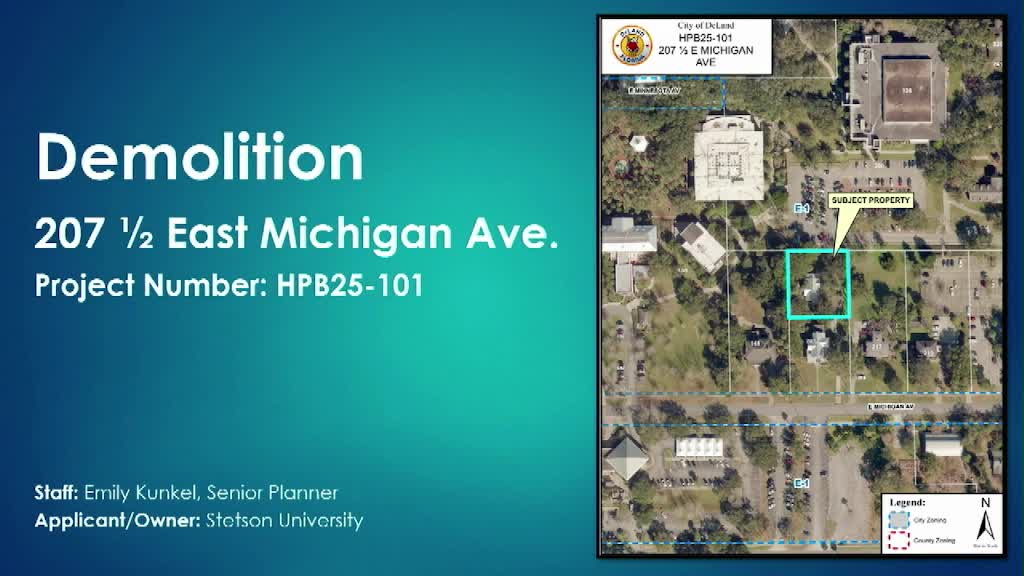
The DeLand City Commission on Oct. 20 approved a rehearing request and authorized demolition of a pre‑1950 structure on Stetson University's property at 207½ East Michigan Avenue after the university presented a facility condition assessment and hazardous‑materials report.
Emily Kunkel (senior planner) reviewed the property's review history: the Historic Preservation Board (HPB) earlier split on a recommendation, and the city commission denied demolition on Aug. 18. Since that decision, Stetson provided a detailed condition assessment that produced a 5‑year facility condition index (FCI) of 43% and a 10‑year FCI of 97%, which the university argued indicates the structure is at the end of its useful life and would require complete renewal. Testing also found asbestos‑containing materials in exterior gunite applied in the 1980s; the university said it would abate hazardous materials under federal and state rules prior to demolition.
Scott Thacker, representing Stetson University, said the building had been moved from its original 1928 site and lacked the historic integrity to warrant preservation. Stetson showed photographs of rot, termite damage and missing glazing, and described a campus master plan that envisions an alumni green and an outdoor art and sculpture garden. Architects and preservation consultants noted some intact original materials (wavy glass) would be salvaged where feasible.
Commissioners asked whether HPB had seen the new assessment prior to its split vote; staff said the full condition report was newly submitted and was not available at the earlier HPB meeting. After applicant presentation and discussion, commissioners moved and passed a motion approving demolition of the structure, with staff and applicant noting abatement and salvage would follow applicable regulations.
The university said the site will be used as green space and to host an outdoor art and sculpture garden, and the first memorial sculpture is planned to honor students who died while enrolled. The decision clears the way for abatement and demolition work to proceed under state and federal hazardous‑materials rules.