
Palm Beach County officials warn proposed homestead tax rollbacks could slash local services
Get AI-powered insights, summaries, and transcripts
Subscribe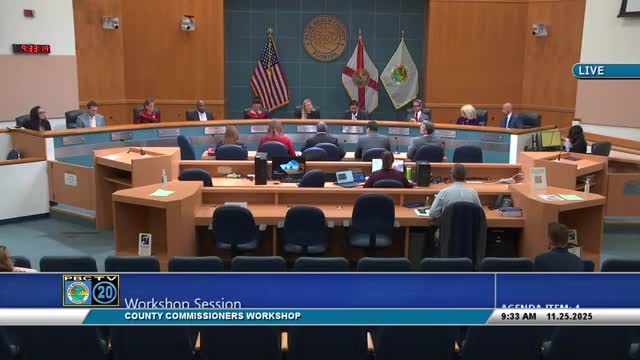
Summary
At a county commission briefing, staff and Representative Toby Oberdorf outlined eight House and Senate proposals that would expand homestead exemptions, portability and other limits on ad valorem taxes. County staff projected hundreds of millions in lost revenue and commissioners pressed for more local scoring, legal guidance and public outreach.
Todd Von Lauren, the county’s chief deputy administrator, told the Palm Beach County Board of County Commissioners that several House and Senate proposals now under way would sharply cut local ad valorem revenue if voters or the legislature adopt them.
“The assessed value of property times your millage rate” is how Von Lauren explained property taxes, and he warned the board that the largest House joint resolution studied — HJR 201 — could reduce county revenues by hundreds of millions of dollars. He summarized staff estimates and the state’s revenue conference scoring, saying the county’s analysis shows a major‑fund impact and the state conference estimated a roughly $963,000,000 countywide effect for that measure.
Why it matters: property taxes fund a range of county services the board controls. Von Lauren told the commission the county’s current ad valorem levy is about $2.167 billion and that reductions under some proposals would hit the roughly $609 million the board directly oversees for BCC departments and capital projects. “A 20% reduction to our BCC departments is about $110,000,000,” he said; the staff scenario for some proposals equates to far larger cuts.
Representative Toby Oberdorf, chair of the House Select Committee on Property Taxes, described the committee’s outreach and the legislative path. He said the seven House joint resolutions and one House general bill being discussed propose constitutional amendments that would go to voters if each joint resolution passes both chambers by supermajorities and withstands a Supreme Court review. “None of the proposals directly conflicts,” Overdorf told the board, adding that implementation statutes would follow any successful ballot measures.
Board members pushed back with questions about the local impact. Administrator Abruzzo cautioned that using reserves to backfill large revenue losses could imperil the county’s credit rating; he reported that the county’s credit‑rating agencies had warned against falling below current reserve levels. Commissioners repeatedly asked staff to map reductions to specific departments and services, noting engineering, roads, parks, permitting and public‑facing programs would be among the most affected.
Equity and spillover effects were central concerns. Several commissioners said eliminating or greatly expanding homestead exemptions would shift tax burdens to non‑homestead payers — including small businesses and rentals — and could cause municipal contractions in smaller jurisdictions that are heavily homestead‑based. Commissioner Flores noted the county’s demographics and cautioned that many residents would be affected: “We have a lot of poverty. We have a lot of homelessness,” she said, urging that staff and legislators consider those communities.
The county presentation walked the board through several specific measures: a complete elimination of non‑school homestead taxes (HJR 201), phased exemptions over 10 years, 65‑and‑over exemptions, a 25% homestead exemption option, an insurance‑linked $100,000 (later amended to $200,000) exemption, portability expansions that would allow full transfer of Save Our Homes benefits, and rules changing assessment caps and millage‑increase thresholds. Staff provided numerical estimates and emphasized some variance between the county’s numbers and the state revenue‑conference scores because of differing assumptions.
Timing and next steps: Overdorf and staff said legislative committees are scheduled through December and the House could move measures to the floor in January; joint resolutions must pass both chambers by supermajority to reach the ballot, and the court will review ballot language before placement. If voters approve an amendment in November, implementing statutes and administrative rules would be required in advance of the January 1 valuation date that would affect the next cycle’s tax bills.
Legal and public‑information limits: commissioners asked what the county may legally tell the public about likely ballot items. County staff said state law restricts county advocacy and even some mailings about foreseeably on‑ballot measures; staff pledged to bring clear legal guidance on what the county can and cannot distribute and to coordinate public information within those constraints.
The board did not take formal votes on any of the bills during the session. The only formal action early in the meeting was a procedural motion to receive an item into the file, which passed 7–0.
What to watch: staff said they will continue to refine local impact numbers as the Legislature and the state revenue estimating conference score bills. Commissioners asked for timely, clear mappings of specific departmental exposures and legal parameters for public outreach so residents can be informed about what a ballot decision would mean for local services and budgets.
Ending note: Representative Overdorf said his committee’s purpose was to explore options to return money to Floridians while protecting law‑enforcement funding and school taxes; commissioners said they welcome further dialogue but urged careful local analysis and public education before any ballot referral moves forward.