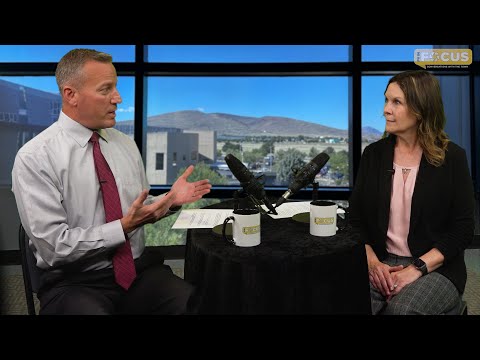
Prescott Valley public works director outlines road, safety and trail plans
Loading...
Summary
Heather Reuter, a director in Prescott Valley’s Public Works Department, described major projects including a state-funded Glassford Hill Road expansion, a 24–26 mile Lasso Loop multiuse path, pavement-preservation planning using a pavement condition index and safety projects from a Safe Streets for All grant.
Heather Reuter, a director in the Town of Prescott Valley’s Public Works Department, told the town’s PV in Focus podcast that the department manages nearly 300 miles of roadway and a broad network of stormwater and traffic infrastructure and is preparing several projects to improve capacity, safety and multimodal access.
Reuter said the town secured supplemental state funding to expand Glassford Hill Road, adding a third lane northbound and southbound from State Route 89A down to Long Look. "We're able to improve the capacity by adding a third lane northbound and southbound from SR 89A all the way down to Long Look," Reuter said, adding the project spent about a year in design and the town hopes to begin construction after the new year.
The Glassford Hill project will include sidewalks and multiuse paths on both sides of the roadway, the director said, and will add bicycle facilities to make travel safer for people who walk and bike. Reuter also described solar-powered pedestrian crossings currently under construction aimed at improving safety at parks, schools and neighborhood crossings.
To guide pavement work across the town’s nearly 300 miles of roads, Reuter said the department hired a contractor to score pavements using a pavement condition index (PCI). "We actually called out a contractor to drive all of our roads and give us a pavement condition index number," she said. The scores feed a five-year pavement preservation plan; overlays typically extend pavement life by roughly five years, and the town re-scores roads periodically to update priorities.
Reuter pointed to Glassford South as an example of deferred maintenance that required full reconstruction after pavement preservation was not performed in time. The pavement-preservation approach is intended to prioritize limited dollars where they extend useful life and avoid more costly rebuilds.
On safety planning, Reuter described a Safe Streets for All grant that funded a data-driven review of crashes over the prior five years (pedestrian, bicycle and vehicular) and identified small-scale improvements that could reduce serious injuries as the town works toward Vision Zero. Potential fixes include connection of multiuse paths, intersection improvements, visibility and sight-line work, and changing skewed intersections into T-intersections.
The department applied for a supplemental implementation grant aimed at funding eight projects identified by the safety plan, Reuter said, and is awaiting funding decisions that would accelerate those projects.
Reuter summarized how Public Works is funded: Highway User Revenue Fund (the state gas tax), stormwater rates and the town’s general fund. She emphasized legally restricted uses for each source and that staff must allocate funds according to those restrictions.
Discussing longer-term priorities, Reuter said the town recently completed the Lasso Loop planning document — a proposed 24–26 mile multiuse path encircling Prescott Valley with spurs into retail, residential areas and schools — and said she would prioritize implementing that plan if additional funding were available.
Reuter asked residents to report maintenance needs through the town’s online work-order system (which allows a user to drop a pin) or by phone so staff can respond; she described residents as the department’s "eyes and ears."
The episode closed with the host noting it was PV in Focus’s final episode for 2025 and expressing optimism about project work in 2026.