Get Full Government Meeting Transcripts, Videos, & Alerts Forever!
Get email alerts on the ADOA Building Renewal topic
No spam. Unsubscribe anytime.
Committee gives favorable review to ADOA FY2026 building renewal after debate on priorities
Summary
JLBC staff outlined ADOA's $21.9 million FY2026 building renewal plan, including specific funds for HVAC, fire/life safety, roofs and ADA; members debated the plan's timing amid tight fiscal forecasts and federal HR1 impacts before approving a favorable review 7–4.
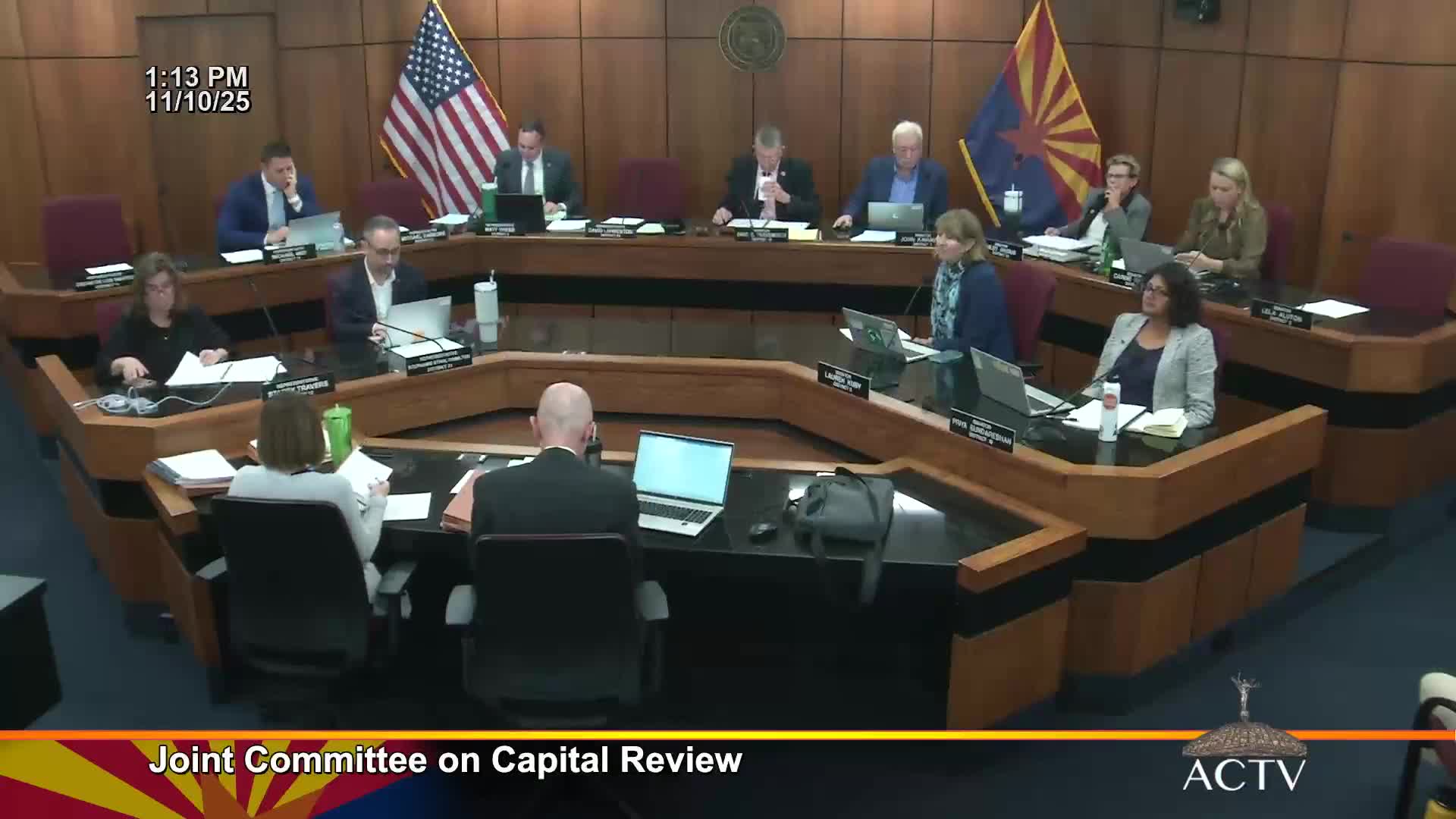
JLBC staff presented the Arizona Department of Administration's FY2026 building renewal appropriation, and the Joint Committee on Capital Review voted to give a favorable review after a substantive debate about fiscal priorities.
Destin Moss of JLBC told the committee that the FY2026 appropriation totaled $21,900,000, with $20,300,000 allocated across categories: $9.8 million for HVAC, elevator, plumbing and electrical upgrades; $4.7 million for fire and life safety projects; $2.5 million for roof replacements and exterior work; $1.8 million for preventative maintenance; $1.5 million for parking, roads, security and infrastructure; and $69,000 for ADA compliance. The remainder—$1.6 million—was planned for administrative expenses, project scoping and an emergency contingency.
Representative Gress raised concerns about proceeding with a $21.9 million expenditure plan while the governor's office had issued guidance on a tight fiscal outlook and while the committee anticipates fiscal impacts from federal legislation (referred to in the record as HR1). "If it's between the building system and K–12 education, I'm going to choose K–12 education," Gress said. JLBC staff clarified that $1.6 million is direct general fund, while most of the appropriation comes from the Capital Outlay Stabilization Fund, which collects agency rent and can include monies transferred from various sources.
After discussion about the need to invest in deferred maintenance to avoid higher costs later, a motion to give a favorable review was called and the committee approved the review by roll call, 7 ayes to 4 noes.
The committee recorded that ADOA had supplied a list of 40 specific projects—an uncommon level of specificity compared with prior years—and members asked staff to follow up with details where needed.
The committee's favorable review is advisory; agencies may still need subsequent approvals before expending funds, and the discussion underscored that members want clearer linkage between maintenance choices and broader budget tradeoffs.