Get Full Government Meeting Transcripts, Videos, & Alerts Forever!
Get email alerts on the Utilities And Parks topic
No spam. Unsubscribe anytime.
FPL easement prevents permanent restrooms at Marnie Fields; council to pursue outreach
Summary
City staff told council Florida Power & Light has an easement covering all of Marnie Fields and will not allow permanent structures there, blocking a planned restroom; council discussed interim trailers, sewer hookup costs and drafting a formal letter and lobbyist outreach to FPL.
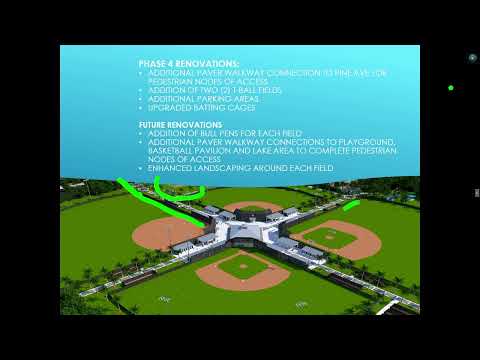
Paul Perino, Bonita Springs parks and recreation director, told the City Council workshop that Florida Power & Light informed staff the Marnie Fields parcels are entirely within an FPL easement and that the utility "does not permit any permanent structures in any part of their easement," blocking staff plans to build a permanent restroom on the site.
Perino said staff reviewed the entire site and found every part of the property the city holds is within FPL’s easement, including recently acquired land. He described options staff is considering: upgrading the existing temporary restroom trailer (the unit on site cost about $30,000), installing a higher‑quality trailer that still requires pump‑outs, or constructing a permanent restroom tied into sewer and water (which staff estimated could cost about $250,000).
“How do we do this?” council members asked. Staff and members discussed negotiating with FPL for a perimeter location or an exception, or posting a demolition bond to address FPL’s operational concerns. City legal and operations staff said FPL’s core worry is access and timing: if the utility needs to work in the easement, it wants the ability to remove structures quickly without long demolition processes. One staffer said that addressing FPL’s concerns could require a posted bond that would cover demolition costs and be renewed, which would be expensive to maintain.
Perino told council the city has FPL responses in writing and that Charlotte Miller at FPL had followed up to confirm the stance. Council members proposed escalating the issue by drafting a formal letter for the mayor’s signature, engaging the city lobbyist and, if needed, directing outreach higher in FPL’s management or to state regulators so the city can negotiate a perimeter solution or a written denial.
Council also reviewed the larger context of undergrounding high‑voltage transmission lines. Perino said FPL provided an estimate of about $21,000,000 for undergrounding the high‑voltage stretch near the fields; another council member referenced a higher figure of roughly $105,000,000, underscoring the major cost and practical differences between undergrounding transmission versus distribution lines.
Next steps: staff said they will draft outreach materials for the mayor’s signature, coordinate with the lobbyist to identify the appropriate FPL contacts, and return to council with a recommended path for either negotiating a perimeter placement, selecting a higher‑quality temporary unit approved by FPL, or pursuing sewer hook‑up estimates. No formal council action or vote was taken at the workshop.