
Anne Arundel school board approves Phase 2 redistricting after hours-long debate
Get AI-powered insights, summaries, and transcripts
Subscribe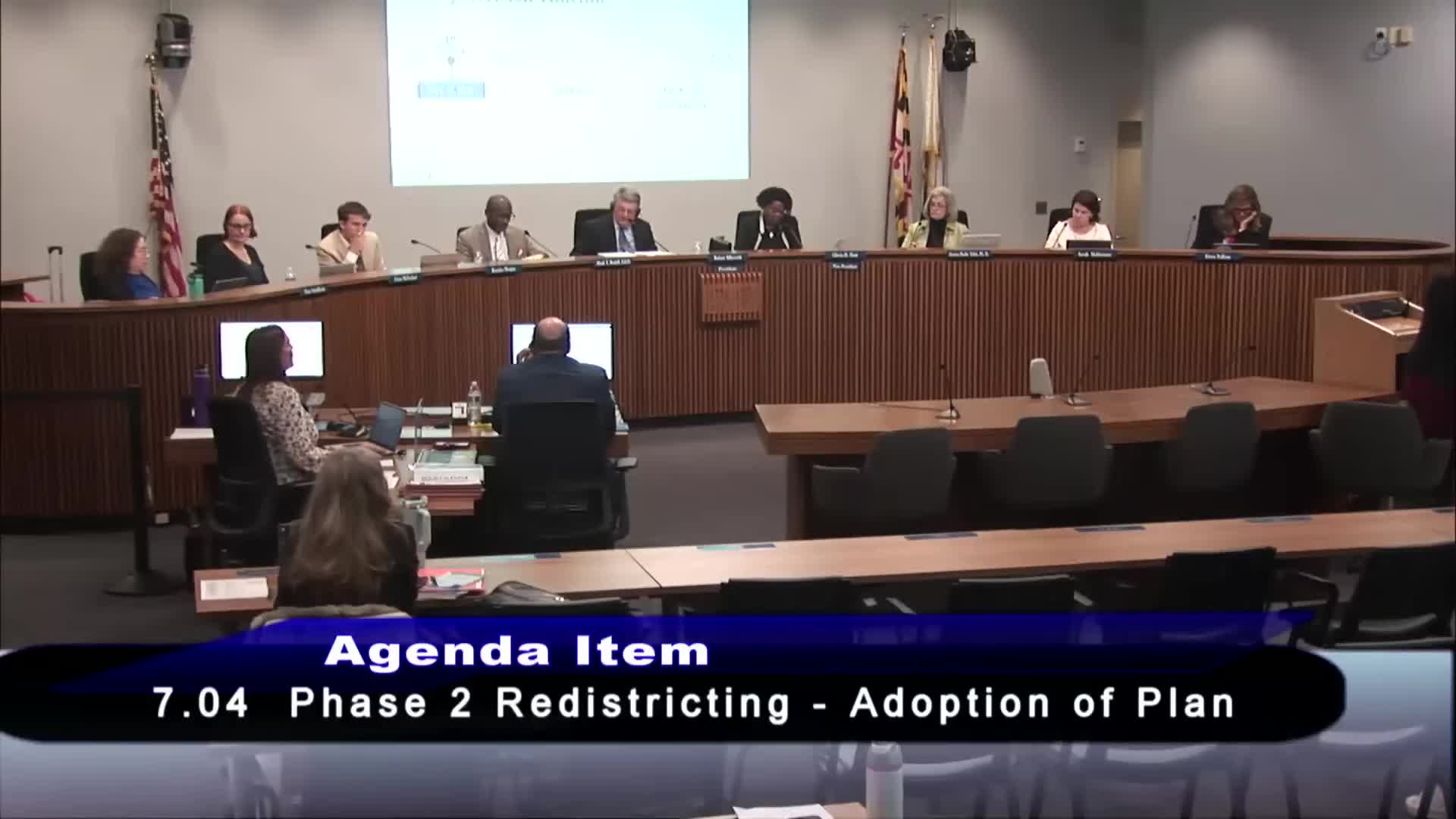
Summary
After hours of testimony and multiple tied amendment votes, the Anne Arundel County Board of Education approved revised Board Recommendation 3 — the Phase 2 redistricting plan — on a 5-3 roll call. Board members and staff debated capacity projections, transportation safety on Route 3, legacy transfers and the timing of planned school additions.
The Anne Arundel County Board of Education voted 5-3 on Wednesday to adopt its Phase 2 redistricting plan, moving students among several clusters to balance building utilization after months of public input and a night of heated debate.
The decision came after the board considered several amendments that failed on 4-4 ties, including a proposal to remove a split articulation for Nantucket Elementary and another to keep 27 families in the Davidsonville attendance area. "I make decisions with my heart," said Board Member Miss McFarland during debate, "but I need to use my head and focus on the data" when explaining her opposition to the amendment to split Nantucket92s matriculation pattern.
Why it matters: The redistricting plan is intended to reduce overutilization at several schools and position the district for capital investments. Supporters said the moves will improve class sizes and operations; opponents warned that some families will face disrupted childcare, additional travel on Route 3 and short-term overcrowding at target schools until planned additions are built.
Staff defended the plan with enrollment projections and capital plans. Mr. Roof, the district—s enrollment lead, told the board the Educational Facilities Master Plan (EFMP) shows some high-school enrollments trending down over the next decade but cautioned that projections remain unofficial until state data are finalized in spring. Board members pressed staff about the timing and size of planned expansions; staff said Arundel Middle appears in the CIP with design expected to start in 2028, while Crofton has limited expansion room and uses portables.
Transportation and equity were central to the discussion. Several board members raised safety concerns about sending buses or students along Route 3; others argued that students routinely travel longer distances across the county and that Phase 1 moves had produced positive results. "We learned in Phase 1 that schools receiving new students can and did succeed," Superintendent Dr. Bedell said, pointing to improved conditions after prior boundary changes.
The board also considered, and rejected, an expansion of a legacy-student provision that would have allowed rising fifth-, eighth- and eleventh-graders to remain at their current schools if families provided their own transportation. Opponents cited operational burdens, parking shortages for older students and the risk of creating unequal outcomes for families without private transportation.
The vote and next steps: With the motion to adopt revised Board Recommendation 3 passing 5-3, the board charged the superintendent and staff with implementation. President Silkworth told the audience the district will provide supports for families with special needs and work to smooth transitions. The board said it will continue to monitor capacity and capital scheduling as the district finalizes enrollments and proceeds toward construction planning.