Get Full Government Meeting Transcripts, Videos, & Alerts Forever!
Get email alerts on the Transportation Corridor topic
No spam. Unsubscribe anytime.
Forward Pinellas outlines East Bay–Roosevelt corridor study to Largo Planning Board; PSTA to increase service frequency
Summary
Forward Pinellas presented Phase 2 of an East Bay–Roosevelt corridor study to the Largo Planning Board, highlighting rising crash rates, pedestrian hotspots, constrained right-of-way and a planned PSTA frequency increase from 30 to 15 minutes. Staff asked for board feedback on ADA, crossings and node prioritization.
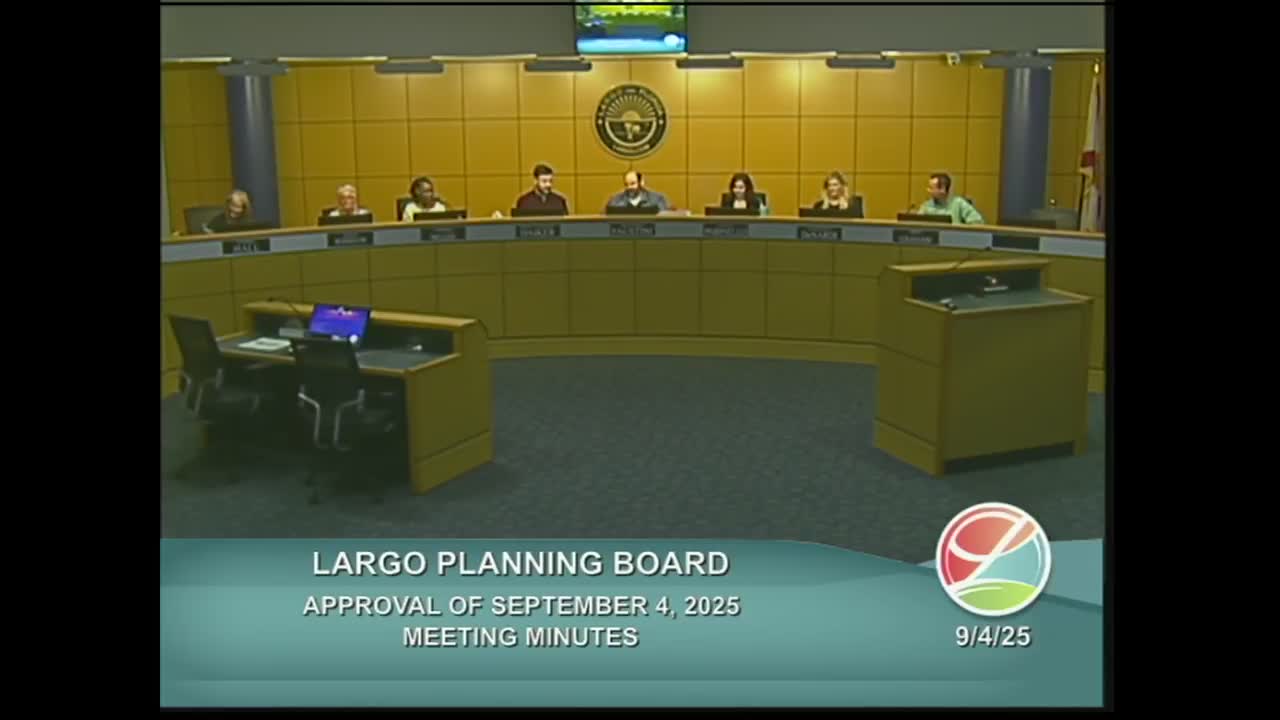
Forward Pinellas presented plans for the East Bay–Roosevelt corridor to the Largo Planning Board on Oct. 2, 2025, outlining recommendations to improve safety, multimodal access and implementation steps in coordination with FDOT and PSTA. Nosheen Ramon, principal planner at Forward Pinellas, said the study covers East Bay Drive from 20th Street to Ulmerton/PIE and focuses on segments and intersections where investments could be prioritized.
The presentation said Phase 1 identified the highest traffic volumes between Keene Road and U.S. 19 and pedestrian hotspots around Alt 19, Highland and Keene. Ramon said crash hot spots often overlap with areas of high pedestrian activity and that right-of-way constraints will require design solutions that fit existing space. "We plan for the vision of the county," Ramon told the board, noting the study will produce an action plan in Phase 3 that lists recommended projects and potential funding paths.
Ramon also told the board that PSTA is updating its network and that service on this corridor will shift from 30-minute headways to 15-minute headways starting at the end of the month, a change Forward Pinellas will consider when shaping recommendations. "PSTA is going to be updating their network... that service will actually go from 30 minutes to 15 minutes," Ramon said.
Board members and residents raised ADA and accessibility concerns, asking whether Phase 1 specifically evaluated pedestrians with mobility limitations. Ramon said Phase 1 documented counts and inspected ADA conditions of sidewalks and ramps and that ADA improvements are included in the city CIP and FDOT work program; Forward Pinellas will incorporate needed ADA upgrades into its recommendations. The presentation also noted some locations force pedestrians to walk up to a mile for a safe crossing, and Ramon said mid-block crossings or pedestrian refuges could be options when space is limited.
Specific local concerns were flagged during Q&A: residents called out missing signage at Highland, high-speed turning maneuvers near US 19 approaches, and areas around senior housing near Keene and East Bay Drive where safer crossings are a priority. Ramon said lighting and signage improvements, curb extensions to shorten crossings, and turn-radius modifications are among the design strategies under consideration and that some FDOT and city projects (repaving, resurfacing, 10-foot sidewalks on parts of West Bay Drive) are already programmed.
Forward Pinellas invited written feedback and encouraged the public to complete a short QR-coded survey; Ramon offered to send the Phase 1 report (109 pages) to staff for distribution. The study will move into a mobility evaluation and then an action plan that will identify priority nodes and steps for implementation, with Forward Pinellas coordinating with FDOT, PSTA and Pinellas County on sequencing and funding.
Next steps: Forward Pinellas will use the board’s feedback, PSTA ridership changes and programmed FDOT/city projects to refine recommendations and develop Phase 3 implementation actions. Ramon left contact information and a survey for further input.