Get Full Government Meeting Transcripts, Videos, & Alerts Forever!
Get email alerts on the Wetlands Weyerhaeuser topic
No spam. Unsubscribe anytime.
Alachua County approves limited wetland impacts at Hawthorne Industrial Park with off‑site protection
Summary
The county commission voted unanimously to allow up to 44 acres of wetland and surface-water impacts at the Hawthorne Industrial Park outside a designated 39-acre wildlife corridor, and required the applicant to place a 443‑acre off‑site mitigation area into permanent protection before any impacts occur.
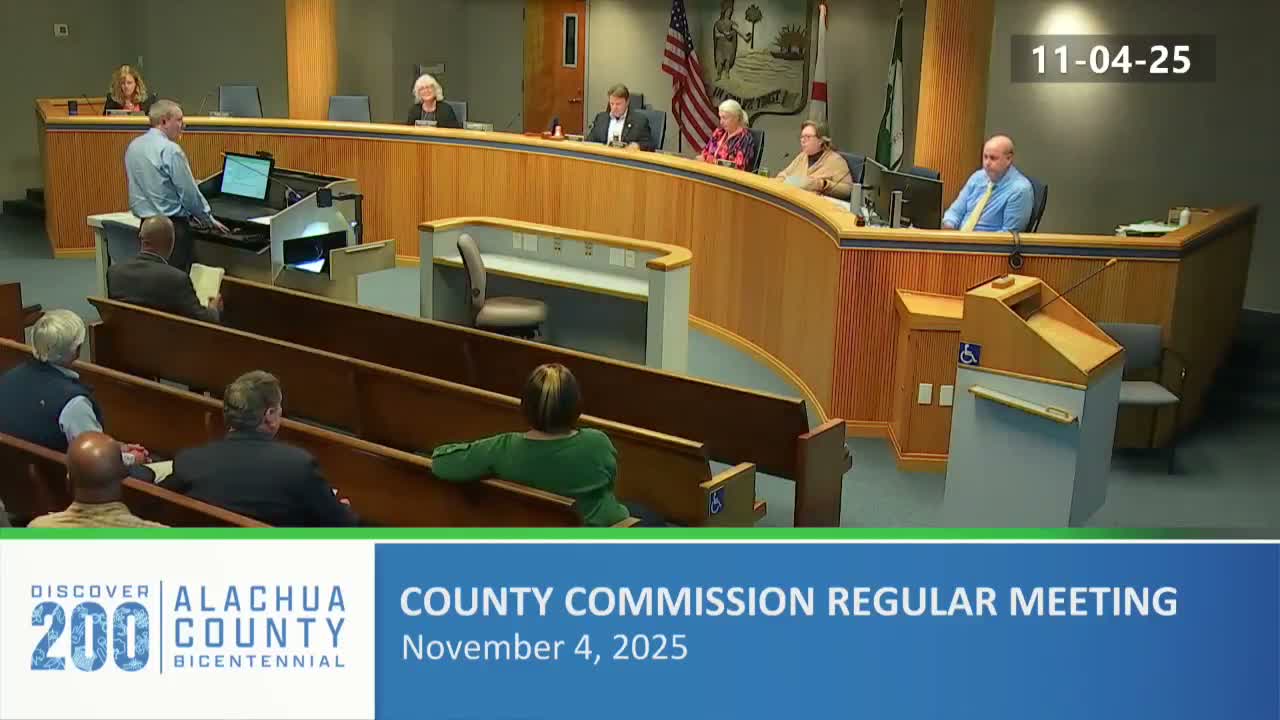
Alachua County commissioners voted unanimously to authorize limited wetland impacts at the Weyerhaeuser Hawthorne Industrial Park while requiring a large off‑site mitigation area be permanently protected before any work begins.
The decision, made after a daylong quasi‑judicial hearing, modifies staff’s original recommendation to limit impacts to 15 acres and instead authorizes up to 44 acres of wetland and surface‑water impacts within the project boundary but outside a 39‑acre delineated Wildlife Corridor Conservation Area. The board specified that only the east–west rail spur and an access roadway may impact the wildlife corridor without returning to the Board of County Commissioners for additional approval. The motion passed unanimously.
Why the board acted
County Environmental Protection Department (EPD) planner Mark Brown told commissioners the applicant’s conceptual plans — permitted in part by the Army Corps and the Water Management District — showed roughly 83 acres of direct wetland impacts and roughly 87 acres of buffer impacts. Brown said staff’s evaluation found the application did not meet all criteria in the countywide Wetland Protection Code and that a strict reading of the code would support a 15‑acre limit, but staff had worked with the applicant on an Avoidance, Minimization and Mitigation (AMM) approach.
“Staff does not agree with … the 83 acres of wetland surface water impacts and 87 acres of buffer impacts,” Brown said, but nonetheless recommended a limited approval with conditions and tracking to ensure mitigation goals are met.
Applicant, city and expert testimony
Clay Swagger of EDA Consultants, representing Weyerhaeuser, framed the proposal as a rare economic opportunity for Hawthorne and eastern Alachua County: a rail‑served, >1,000‑acre site in a federally designated opportunity zone. “This is a very unique opportunity,” Swagger said, asking the board to recognize an overriding public interest to justify impacts beyond the code’s generic cap.
Weyerhaeuser environmental consultant Mike Dennis and legal adviser David Coffey testified that federal and state permitting work (including a Corps of Engineers section 404 permit and a Water Management District ERP permit) had been completed in concept, that many of the impacted areas had been managed as pine plantation for decades, and that the off‑site mitigation parcel lies within the county’s strategic ecosystem mapping. Dennis told the board, “We have the Corps of Engineers 404 permit in hand. We have the Water Management District’s ERP permit in hand.”
Coffey argued approving the impacts and securing the applicant’s mitigation would subject both the development site and the off‑site mitigation property to permanent protections: “The entire off‑site mitigation property will receive perpetual protection by a conservation easement established upon your approval,” he said.
Commissioner concerns and the compromise
Commissioners pressed staff and the applicant on several tradeoffs: whether large‑scale mitigation proposed off‑site should count against an in‑place cap, how the site would be parceled and developed (phased user‑by‑user versus wholesale grading), and whether the county could structure incentives so individual tenants would actively avoid wetlands.
Commissioner Prizia proposed the compromise that passed: retain staff’s protections for identified conservation areas and the Wildlife Corridor, permit up to 44 acres of impacts outside the corridor (a figure derived by subtracting the 39‑acre corridor from the applicant’s 83‑acre concept), allow only the rail spur and access road within the corridor without further BOCC approval, require construction‑level ERPs be submitted to the Water Management District concurrently with county CWPC applications, and require the off‑site mitigation area to be placed into permanent protection prior to any wetland or surface‑water impacts.
Public comment and board vote
Public commenters were split. Environmental speakers urged rejection or more study, questioning past practices by large timber companies and warning of long‑term habitat and water‑quality effects. Business, chamber and city leaders said the site’s rail access and scale are rare and vital to attract major employers. The board then voted — voice vote — in favor of the Prizia motion; the chair declared the motion unanimous.
What the approval requires next
Per the board’s direction, Weyerhaeuser (or any subsequent property owner) must:
- Record permanent protection (conservation easement or equivalent) over the identified off‑site mitigation property (the applicant has described this off‑site mitigation as roughly 443 acres) before any wetland or surface‑water impacts authorized under the motion may occur; - Submit construction‑level Environmental Resource Permits (ERPs) to the St. Johns River Water Management District concurrently with countywide Wetland Protection Code applications; and - Coordinate with EPD staff and district staff to document and track actual impacts and mitigation acreages during buildout so impacts are accounted for over time.
The board also kept control over any future proposal that would increase impacts inside the Wildlife Corridor Conservation Area: those would require a separate BOCC decision under the countywide code.
Why it matters
The vote reflects the county’s attempt to balance strict local wetland protections enacted in the countywide code with a developer’s argument about a rare, rail‑served industrial site that could attract large employers. The ruling does not eliminate county oversight: it adds conditions designed to lock in off‑site protections and require construction‑level review for any future activity.
Next procedural step
EPD staff and the applicant will finalize paperwork to implement the conditions the commission required; individual tenants and construction permits must still complete technical reviews before any ground‑disturbing activity occurs. The county’s action authorizes impacts subject to the stated conditions but does not, by itself, authorize construction until district ERPs and county permit applications are submitted and approved.