Get Full Government Meeting Transcripts, Videos, & Alerts Forever!
Get email alerts on the Infrastructure topic
No spam. Unsubscribe anytime.
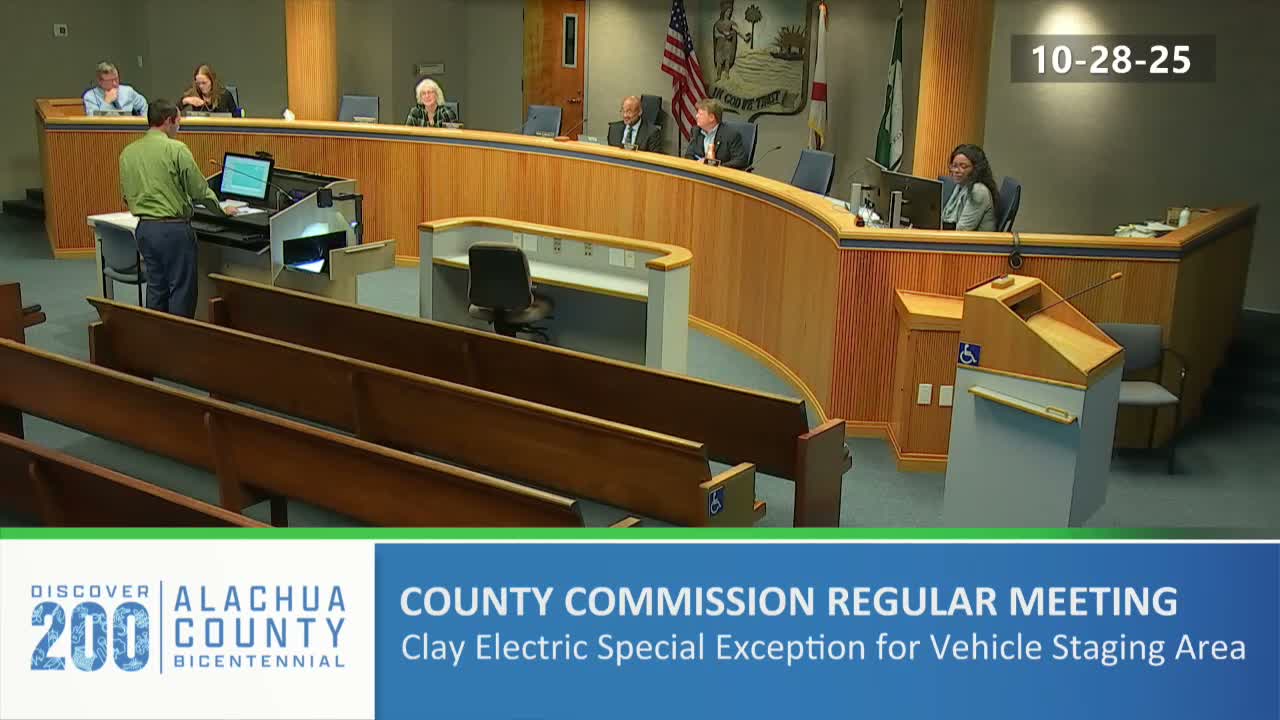
Commission approves Clay Electric's special exception for emergency vehicle staging area
Summary
After a quasi-judicial hearing, the board approved Clay Electric's request for a 7.92-acre vehicle-staging special exception adjacent to its existing office, subject to buffers, stormwater controls and conditions to limit impacts to nearby residents.
Alachua County commissioners approved a special exception on Oct. 28 allowing Clay Electric to use a 7.92-acre parcel as a temporary vehicle-staging area for emergency deployments.
Growth-management staff described the application as an institutional use allowed by policy and recommended approval with conditions tailored to the site's residential adjacency: reduced but specific buffers, temporary lighting oriented away from neighbors, stormwater controls and coordination with the county's environmental protection department for any hazardous materials used during staging.
Applicant representatives said the site will be stabilized with compacted gravel (not an asphalt lot), include a stormwater basin sized to county and Water Management District standards, and be used intermittently during major events. Engineer Tim Bayline told the board the staging plan anticipates roughly 100 to 120 vehicles and temporary support trailers (showers, food service and bunk trailers) during large emergency responses. "There will be some trailers specifically for bunk beds and sleeping for the workers," he said.
Neighbors and environmental commenters raised questions about tree removal and habitat impacts and asked whether the county had considered alternative staging sites. County staff said the project will include required environmental resource assessment and that the Environmental Protection Department had not identified unresolvable concerns at the preliminary stage.
The board approved the special exception with the staff-recommended conditions and a 40-foot buffer adjacent to a residence, along with standard temporary-lighting and hazardous-material coordination terms.
What happens next: the applicant will produce final development plans showing stormwater, buffer planting/retention and surface stabilization; the county will review those plans through its development-review process before any staging occurs.
Sources: Growth Management staff report and presentation; applicant testimony from Tara Howell and engineer Tim Bayline; public testimony at Oct. 28 meeting.