
BPAC hears how Illinois’ SB 2111 (’People Over Parking’) could reshape Urbana transit and development
Get AI-powered insights, summaries, and transcripts
Subscribe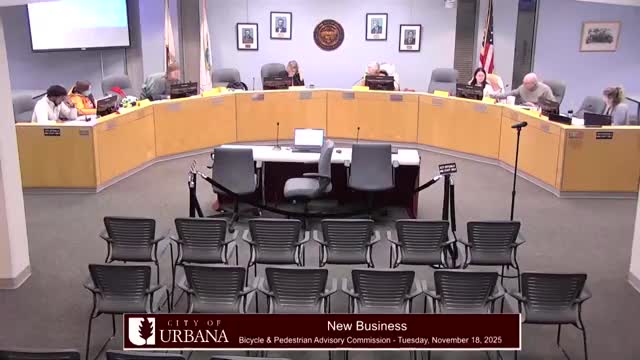
Summary
At its Nov. 18 meeting, Urbana’s Bicycle & Pedestrian Advisory Commission heard a detailed briefing on Senate Bill 2111 — the 'People Over Parking Act' — including new transit funding streams, the creation of a Northern Illinois Transit Authority, and removal of parking minimums near transit stops and hubs, and discussed local opportunities for first/last-mile improvements.
A presenter at the Nov. 18 meeting of the Urbana Bicycle & Pedestrian Advisory Commission outlined how Illinois Senate Bill 2111, the so-called People Over Parking Act, could affect Urbana's walking, biking and transit systems if it becomes law.
The presenter told commissioners the 1,000-plus-page bill treats transit and active transportation as interconnected infrastructure rather than separate programs and creates a stronger state role in coordinating services and funding. "It fundamentally reconceived the role of passenger rail and public transportation in the state's economic and social fabric and wrote that vision directly into law," the presenter said during the briefing.
Why it matters: Commissioners were told the bill would redirect state sales-tax revenue on motor fuels to transit operations, with staff citing an estimated $860 million annually in new revenue. That revenue was described as split roughly 15% for downstate operations and 85% to the new Northern Illinois Transit Authority (NITA). The presenter said interest from the road fund would also be directed to transit capital spending (estimated around $200 million, with 10% to downstate agencies and 90% to CTA, Metra and PACE). Those funds, the presenter said, could make first- and last-mile street improvements — sidewalks, boarding pads and shelters — easier to fund alongside regular street work.
Key provisions and local impacts: The presenter emphasized two provisions likely to affect Urbana directly: the bill's removal of mandated parking minimums within defined proximity of transit "hubs" and the establishment of a transit-to-trails grant to improve bus access to recreational areas and support environmental justice communities. "It removes parking minimums on Lincoln, Green, Washington, and other streets," the presenter said, noting the law applies to new construction or renovation (not hotels or transient lodging) and to communities that are home-rule (like Urbana). Commissioners discussed how that change could lower development costs and enable conversion of ground-floor parking into housing or retail.
Commissioners asked for clarification about how the bill defines "access to transit"; the presenter summarized the measure's thresholds — for example, a 1/2-mile radius around hubs and street segments served by buses at 15-minute peak frequencies. Commission discussion noted that Champaign already eliminated minimum parking requirements in some areas and that ready local planning and data from MTD would be important to position Urbana for grants and early funding.
Questions and next steps: Commissioners discussed the Kankakee Extension study and possible intercity rail connections to Champaign–Urbana, as well as how the bill could enable new funding for local priorities such as a Downtown Urbana transit hub and a route to Weaver Park or the Kickapoo Rail Trail. The presenter said additional materials and slide decks would be shared with the commission and that staff would work with the city planner (a new hire expected in December) to model where Urbana might qualify for transit-related funds.
The presenter closed by calling the bill a systems-building measure and urged commissioners to stay informed: "The opportunity now rests in execution," the presenter said. The presentation slides will be shared with BPAC and included in the next meeting packet.
The commission did not take formal action on SB 2111 during the meeting; the briefing was informational. The presenter said the governor's signature remained the final step before funds and new authorities become effective.