Get Full Government Meeting Transcripts, Videos, & Alerts Forever!
Get email alerts on the Sb2111 topic
No spam. Unsubscribe anytime.
Urbana BPAC member summarizes sweeping Illinois transit bill; says "People Over Parking" will reshape local planning
Summary
BPAC member Annie Adams told Urbana's Bicycle & Pedestrian Advisory Commission that Illinois' SB 2111 reframes transit as infrastructure, creates a Northern Illinois Transit Authority, directs an estimated $860 million in sales-tax revenue to transit, and prohibits parking minimums in transit-served areas, opening grant opportunities for Urbana.
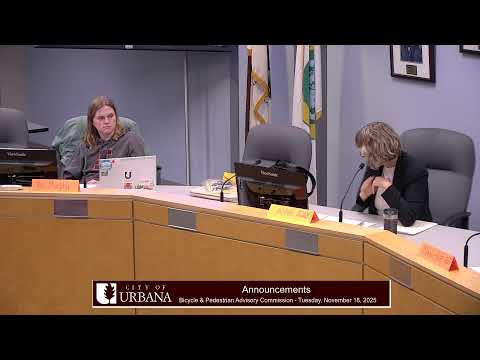
Annie Adams, a member of the Urbana Bicycle & Pedestrian Advisory Commission (BPAC), summarized Senate Bill 2111 and told commissioners on Nov. 18 that the measure treats "mobility as essential infrastructure rather than a social service." The presentation outlined how the 1,000-page package would change funding, governance and land-use rules that affect Urbana.
Adams said SB 2111 creates a new Northern Illinois Transit Authority (NITA) to replace the Regional Transportation Authority and to coordinate schedules, fares and service between Amtrak, commuter rail and local transit agencies. "They are tasked with creating one network, one timetable, one ticket," she said.
Why it matters: Adams told the commission the bill could unlock new funds and planning tools to support sidewalks, shelters and first- and last-mile connections in Urbana, and that the city should be prepared to compete for targeted grants. She noted the law channels state sales-tax revenue from motor-fuel purchases into transit funding and estimated annual revenue of roughly $860 million, with 15% directed to downstate operations and 85% to large regional operators and NITA.
Adams also highlighted the bill's land-use provisions. "It prohibits mandated parking for new residential and commercial non-hotel uses within a half-mile of a hub, rail stations and bus intersections," she said. The measure, she said, removes local parking minimums in specified transit-served areas, a change Adams and other commissioners called transformative for housing affordability and walkable neighborhoods.
Details and local implications: Adams outlined several grant and program opportunities that could benefit Urbana, including a downstate transit improvement fund, a mass transportation capital improvement fund for intercity rail, and an IDOT transit-to-trails grant for recreational connections. She said the law explicitly connects transit expansion to greenhouse-gas reduction and creates program elements for ADA planning, paratransit coordination and language access.
Adams encouraged the commission to prepare by assembling data and readying project plans so Urbana can compete quickly if funds become available. "If you have your plans ready to go, you're going to be put in front of people who are still trying to figure out high-speed rail and other big questions," she said.
What happens next: The presenter said the bill will require the governor's signature to take effect and that the People Over Parking provisions are scheduled to take effect June 1, 2026. Adams offered to share her slides and supporting links with the commission.
Ending: Commissioners asked follow-up questions about how "access to transit" is defined in the bill (Adams: within a half-mile of a hub or stops with buses every 15 minutes at peak times) and about the breakdown of funds between intercity and intracity projects. Adams advised ongoing engagement with state representatives and early coordination with MTD and city planners to map local opportunities.