Get Full Government Meeting Transcripts, Videos, & Alerts Forever!
Get email alerts on the Healthcare topic
No spam. Unsubscribe anytime.
Panelist argues health care should be reorganized as a commons, removing insurers and billing
Summary
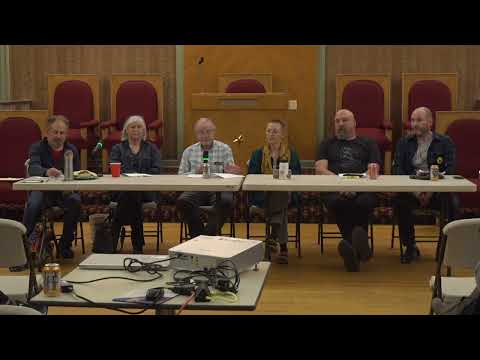
At a Missoula DSA panel, organizer David Quattrucci argued for 'health communism'—a post‑capitalist model where clinics don't bill, insurers are eliminated, and care centers on social determinants like housing and food.
David Quattrucci, a community organizer working with a federally qualified health center in Missoula, told the audience that under capitalism "health isn't a right. It's a sorting mechanism." He described health care under the current system as organized to ration care through billing codes, networks and denials and proposed a post‑capitalist alternative grounded in what he referred to as "health communism."
Quattrucci cited authors and movements (including Beatrice Adler Bolton and Ardie Verkamp's Health Communism and the Socialist Patient Collective) and said a transformed system would remove insurers and billing from clinical care, integrate housing and food access into health services, and build networks of mutual aid and clinics that function as commons. He argued such networks already exist in part—encampment kitchens, medic tents and mutual aid projects—and should be scaled and formalized.
Quattrucci emphasized that this was not merely rhetorical: building alternatives requires organizing capacity, training and community infrastructure. He urged listeners to view clinics, housing and food programs as parts of a shared care network rather than siloed services, and to support local tenant and care organizing efforts that create de‑commodified access to basic services.
The panel Q&A raised feasibility questions about funding and transition paths; Quattrucci and other panelists suggested a mix of local projects, divestment and broader political campaigns rather than immediate statutory mandates.