Get Full Government Meeting Transcripts, Videos, & Alerts Forever!
Get email alerts on the Long Term Recovery topic
No spam. Unsubscribe anytime.
Baker County unveils FEMA-supported long-term recovery and resilience plan with 10 priority projects
Summary
County presenters described a FEMA-facilitated long-term recovery and resilience plan built from resident input that groups 10 priority projects — roads, communications, parks, housing, health navigation and wastewater — and asked project champions to pursue funding and county adoption.
Baker County commissioners on Tuesday heard a presentation of a FEMA-supported long-term recovery and resilience plan that compiles 10 priority projects identified during community meetings and surveys following the 2024 storm season. The plan, described by the project presenter as a “living, breathing document,” is intended to organize local projects so they are grant-ready and easier to fund.
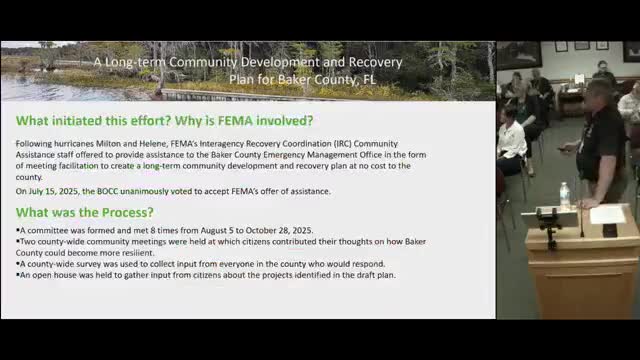
The presenter said FEMA’s interagency recovery coordination staff offered facilitation and technical assistance at no cost and emphasized that county residents helped shape the plan. “Ultimately, it was our citizens, which is a huge benefit in the process,” the presenter said, describing public meetings, a countywide survey and an open house used to solicit input.
The plan groups projects under goals that include maintaining and improving access and mobility, preserving the county’s rural character while managing growth, improving parks and recreation, expanding health-care access, and building community resilience before, during and after disasters. The presenter said project champions have already stepped forward to lead work on individual items.
Top projects identified include a road maintenance and improvement program (Commissioner Bennett agreed to chair the road committee), updates to growth-management and housing development policies, a parks and recreation master-plan update, river-habitat and corridor conservation, a Medicaid/Medicare navigator and broader public‑health outreach, a community communications initiative for catastrophic outages, and generator work for wastewater lift stations in Glen St. Mary. Contractor Jeffrey Winterly was introduced as the project champion for the lift-station generator project.
On communications, the presenter and staff said the county is exploring long‑range solutions to preserve 911 access when power and fiber fail. The county has a Starlink terminal at its emergency operations center and is discussing additional deployments; presenters said possibilities range from donated equipment to partner‑sponsored sites, but that ongoing service costs and security for expensive equipment remain open questions. “We’re looking at this maybe in a couple different pieces,” a project champion said, describing separate acquisition and monthly service costs.
County staff noted existing grant activity: active CDBG grants for Glen St. Mary and McClenny, multiple applications to HMGP and the IRP, and opportunities to coordinate grant submissions across towns and the county. The presenter said project champions will be encouraged to pursue outside funding and public–private partnerships and announced project-management training by the IRC team to help local champions manage grants and deliverables.
Commissioners praised the grassroots nature of the effort but repeatedly warned that funding is limited. One commissioner noted recent resilience investments — a local gas tax for roads and staffing steps at the sheriff and EMS offices — and said many projects will take years and additional funding streams to reach completion. The presenter said each project will eventually include cost estimates and timelines, but many remain in early stages and are being challenged to identify external funding.
The Board was told the next procedural step is for commissioners and the public to review the draft and that staff will return at a later meeting seeking formal adoption so the plan can be integrated into existing county strategic documents. The presenter closed by asking the board and the community to continue supporting the project champions as they pursue funding and implementation.