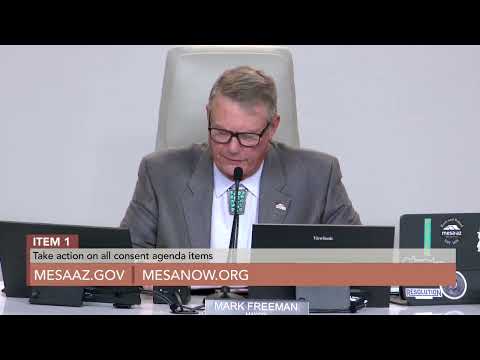
Mesa council approves utility rate adjustments after weeks of debate and extensive public comment
Loading...
Summary
After a long public hearing, the council approved a package of utility fee adjustments (electric, gas, water, wastewater, solid waste) and a revised residential increase targeted at 2.5%, with increased commercial rates and a capacity fee; council emphasized smoothing future increases and committed to transparency.
Mesa City Council approved a set of changes to utility fees on Dec. 1 following a multi‑hour public hearing in which residents urged delay, questioned transfers to the general fund and asked for more transparency.
Staff presentation: Brian Richel, director of the Office of Management and Budget, summarized the rationale for adjustments: equity between residential and nonresidential rates, ensuring growth pays for growth with a capacity fee, conservation incentives and smoothing increases over multiple years. Staff recounted earlier versions of the proposal (initial study committee numbers showed a 5.5% typical residential impact; later staff work reduced the presentation number to 4.2% and council deliberations yielded a compromise residential increase of 2.5%). Richel said the utility fund still faces a projected negative net sources/uses of about $29,000,000 for FY2025‑26 without action.
Public comment: Scores of residents and neighborhood leaders urged council to reject or postpone increases, citing affordability pressures, the size of past transfers from utility funds to the general fund (testimony cited a $9.4 million projected increase in transfers), and the cumulative effect on households living paycheck to paycheck. Speakers included Kerry Davis (who asked that the $9.4M transfer not be included), Reid Gottschalk (urging transparency on how new dollars will be used), Leslie Wilson (District 2 precinct committeeman) and HOA representatives who said they would watch spending priorities closely.
Council discussion and compromise: Council members described an iterative process that trimmed staff's original recommendation—several members cited a compromise that limited the residential increase to 2.5% while allocating more of the adjustment to commercial rates. Members stressed that the 30% utility transfer to the general fund and long‑term budget choices need a broader, separate discussion. Council also highlighted actions to control costs and defer capital projects (noted $180 million in deferred water capital projects) and described a capacity fee anticipated to recover some development costs.
Votes and implementation timing: Council approved each utility item individually. A motion by the Vice Mayor, seconded by Mr. Adams, passed for item 10A (electric fees); subsequent motions to approve 10B (natural gas), 10C (water), 10D (wastewater) and 10E (solid waste) also passed. Staff said the next steps include a notice of intent on Dec. 8 for any increases beyond prior notice thresholds, ordinance introduction in January and an expected action on water rates Feb. 9 with some nonresidential rates effective April 1.
Why it matters: The changes aim to rebalance who pays for utility capital and operating costs and to stabilize utility finances as Mesa invests in water reliability and infrastructure. Residents who testified said the increases are a real burden for families on tight budgets and called for more transparency about how rate revenue and fund transfers are used.
What to watch next: Implementation dates in staff’s timeline (notice Dec. 8, ordinance intro Jan, water vote Feb. 9, implementation April 1 for certain rates), the detailed schedule for the capacity fee, and follow‑up council briefings on the 30% revenue transfer and the budget tradeoffs.