
Waunakee budget panel outlines options to cut $2.3 million levy, shifts enrollment forecasting
Get AI-powered insights, summaries, and transcripts
Subscribe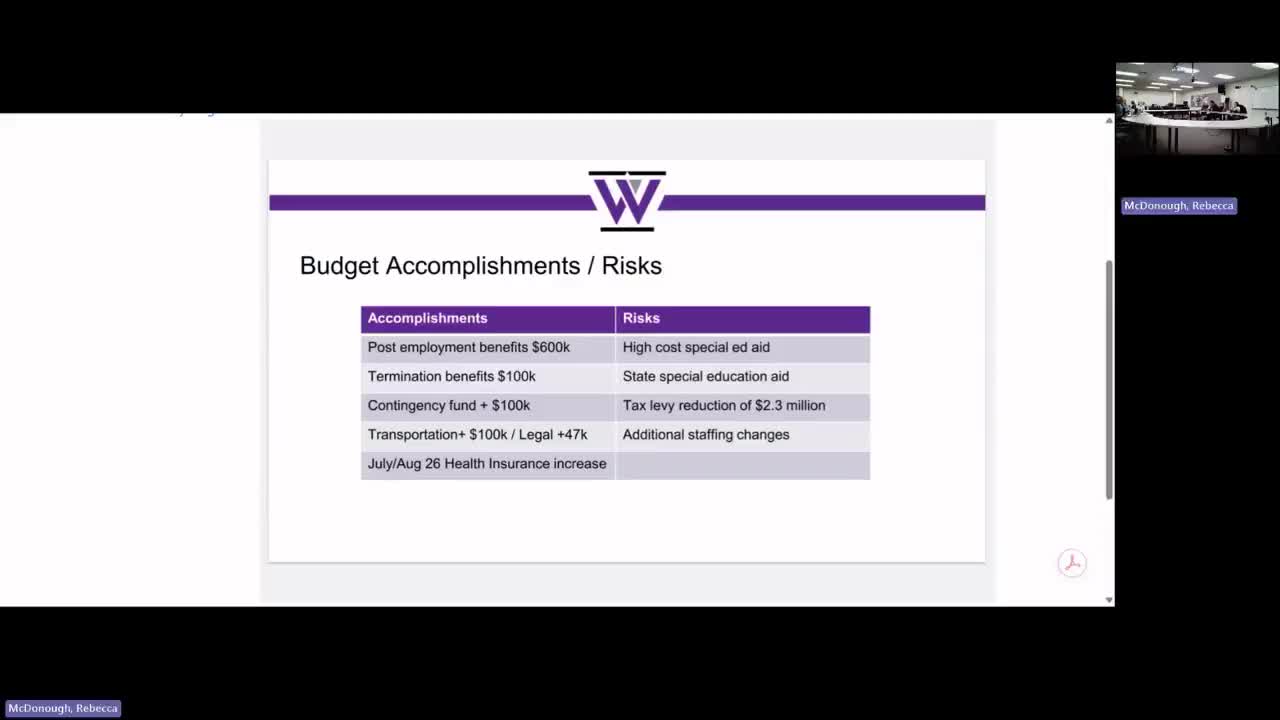
Summary
The Waunakee Community School District budget committee reviewed options to reduce a $2.3 million referendum debt-service levy and adopted a shift from a five-year to a three-year enrollment projection model to better reflect recent smaller cohorts. The committee set a January follow-up to review financing schedules and open-enrollment impacts.
The Waunakee Community School District budget committee reviewed strategies to meet a board commitment to reduce the referendum debt-service tax levy by $2.3 million and approved next steps to analyze financing options.
Speaker 3 told the committee the board’s reductions can be achieved by one or more of three financial strategies: refinancing existing debt, using savings from the November 2022 referendum projects, or applying a federal clean-energy rebate. "Refinancing existing debt would add interest to our long-term debt service schedule but would not force us to use project savings or the clean-energy rebate," Speaker 3 said, adding that each option has different implications for future maintenance projects.
Committee members were also briefed on budget assumptions for 2026–27: a 5% salary-cost projection (approximately CPI plus step increases), a projected 5% health-insurance increase that would likely shift more cost to employees, and a conservative assumption for special-education categorical aid (district planning at 42% versus 45% in the state budget). "We’re taking a conservative approach because some of these state revenue numbers are unpredictable," Speaker 3 said.
To improve enrollment forecasting, the committee approved moving from a five-year to a three-year projection model after the five-year model overestimated growth for 2024–25. Under the three-year model, Speaker 3 said, the district projects 4,393 students (an increase of 24), largely because the upcoming graduating class is unusually small (309 students), reducing the expected gap with incoming kindergarteners.
Speaker 3 asked the committee to reconvene in January to review a debt-service schedule that would address the $2.3 million reduction and to show how a possible high-school capital referendum might affect long-term borrowing and levy calculations. The committee will also discuss open-enrollment parameters at that meeting, including whether to publicize capacity to the broader Dane County community.
No formal board-level decisions on refinancing or use of referendum funds were taken; the committee requested further analysis and scheduled follow-up work for January.