
Oxnard fire chief presses council for investments in paramedics, stations and emergency preparedness
Get AI-powered insights, summaries, and transcripts
Subscribe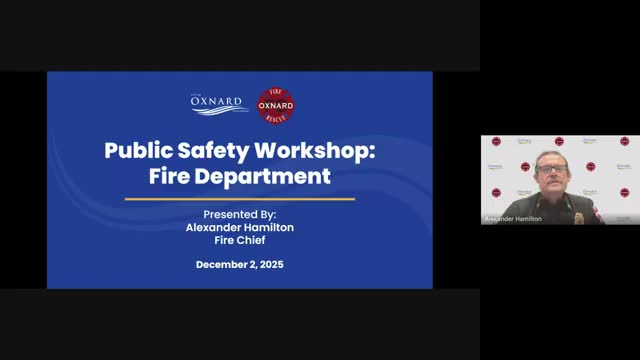
Summary
Fire Chief Alex Hamilton reviewed department capabilities and performance at a council public-safety workshop, urging investment in staffing, paramedic squads, station rebuilds, technology and emergency preparedness while outlining program costs and recent operational gains.
Fire Chief Alex Hamilton told the Oxnard City Council at a public-safety workshop that the Fire Department needs targeted investments to sustain response times, expand paramedic coverage and rebuild aging stations.
"We are here to protect life, property and the environment," Hamilton said, framing a list of near- and long-term priorities that include more emergency response resources, a new training facility and improved analytics to guide deployments. He noted Oxnard currently holds a Class 2 Insurance Services Office (ISO) rating for properties within 1,000 feet of a hydrant and within five miles of a station and said the city is in the top few percent nationally; Hamilton said reaching a Class 1 rating would require further investment.
Hamilton reviewed operational capabilities—fire suppression, hazardous-materials response, urban search and rescue, ocean rescue and mutual aid—citing recent regional deployments to the Palisades and Eaton incidents. He said all members hold at least EMT qualifications and that state‑licensed paramedics provide advanced life support (ALS). "Our goal in the city is to have paramedics on scene within under five minutes," he said, and credited the addition of a second paramedic squad with measurable improvements in ALS response times from 2021 to 2024.
On response benchmarks, Hamilton cited national guidance for arrival staffing and times, describing the widely cited NFPA standard that targets four personnel on scene within four minutes and 15 personnel within eight minutes and linking the four‑person benchmark to OSHA's 2‑in/2‑out safety requirement for interior firefighting. He acknowledged the department does not meet all NFPA benchmarks citywide, said turnout time (the interval before crews depart a station) is the main controllable factor and reported an average turnout of about 56 seconds with overall response times just under five minutes.
Hamilton also described prevention and community programs: the Fire Prevention Bureau's plan checks and inspections, the Certified Unified Program Agency (CUPA) role for hazardous‑materials oversight, a hazard‑elimination collaboration with code enforcement and police, and public‑education work that has included installing more than 7,000 smoke alarms in city homes since 2021. He credited Public Education Specialist Lupi Melkor for that outreach.
The chief summarized workforce supports and research participation: two emotional‑support canines stationed with handlers, two contracted culturally competent clinicians for critical‑incident support, and participation in studies on neurofeedback for PTSD, PFAS exposure reduction and a long‑term firefighter cancer biomarker study involving roughly 30,000 firefighters nationwide.
Hamilton flagged several longer‑term needs: replacement and maintenance of apparatus and ladder trucks, rebuilding aging fire stations, a new training facility to replace the current Oxnard High School site, and new technologies and analytics to improve resource deployment. He estimated a modest lifeguard program would cost about $1,500,000 to start and roughly $800,000 annually to operate and said staffing and funding were barriers to launch.
Closing the presentation, Hamilton thanked the city's communications staff for preparing the materials and invited council and public questions. No formal motions or votes were recorded during the workshop.
Next steps: the presentation positioned council to consider budget and priority adjustments; Hamilton urged discussion on staffing levels, paramedic-squad expansion and capital planning for stations and training facilities.