Get Full Government Meeting Transcripts, Videos, & Alerts Forever!
Get email alerts on the Levy Package topic
No spam. Unsubscribe anytime.
Issaquah board endorses three‑part levy package for February ballot after LEHI advisory review
Summary
After five LEHI advisory meetings and student input, the Issaquah School Board voted to place a three‑part levy (EP&O, capital technology/repairs, transportation) on the Feb. ballot; staff said the package keeps the tax rate effectively stable with assessed‑value adjustments.
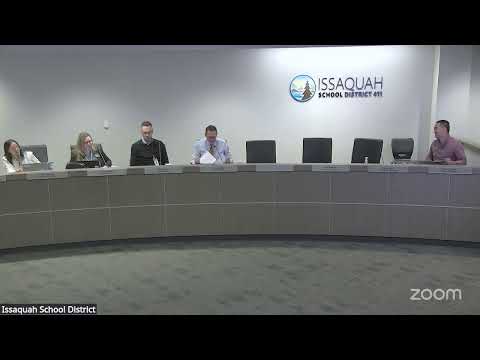
The Issaquah School Board voted Oct. 9 to place three replacement levies on the Feb. ballot after a multiweek review by the LEHI (Levy Advisory) committee and a superintendent recommendation that mirrored the committee's consensus.
The package includes:
• An educational programs and operations (EP&O) levy (four years, 2027–2030) to maintain programs, support staff and daily operations, and fund items the state does not fully cover. The superintendent presented estimated levy amounts and per‑$1,000 assessed value rates for each year (2027: approximately $75.2 million at $1.25 per $1,000; 2028–2030 amounts and rates were read into the record).
• A combined capital levy for technology and critical repairs (four years) that preserves the district’s 1‑to‑1 device program, funds safety/security upgrades and HVAC/roof work, and includes modernization and software/security investments. Staff described a final capital package of roughly $55 million over four years.
• A transportation levy (one year) to replace buses and add electric‑bus charging infrastructure; the committee recommended a modified approach that adds charging capacity at the district’s main facility so piloting is district‑wide rather than confined to a single plateau.
Presenters said the advisory committee, which included more than 60 students, parents and staff, used a consensus model and prioritized keeping tax rates stable while funding equity, safety and student supports. Committee exit scores for the recommended packages were reported in the 4.7–4.8 out of 5 range.
Board members asked staff detailed financial questions, including how assessed‑value updates affect estimated tax rates and contingency planning for capital projects. Martin Turney and Mark Sherwood, who led levy committee communications, described outreach and student participation as central to the committee’s recommendation.
Votes at a glance: the board adopted motions to place the EP&O resolution (Res. 12‑48), the capital projects resolution (Res. 12‑49), and the transportation resolution (Res. 12‑50) on the ballot. The meeting record shows each resolution moved, seconded and approved by voice vote; no roll‑call tallies were recorded in the public transcript.
Board members and staff emphasized that the package is a renewal-style proposal intended to keep tax rates stable while addressing needs the state does not fund (mental health supports, counselors, technology licenses, custodial/operations, and transportation). Several directors and student representatives urged students to help communicate levy impacts to families and voters.