
Palo Alto presents community-garden update: 5 sites, wait lists and fee structure explained
Get AI-powered insights, summaries, and transcripts
Subscribe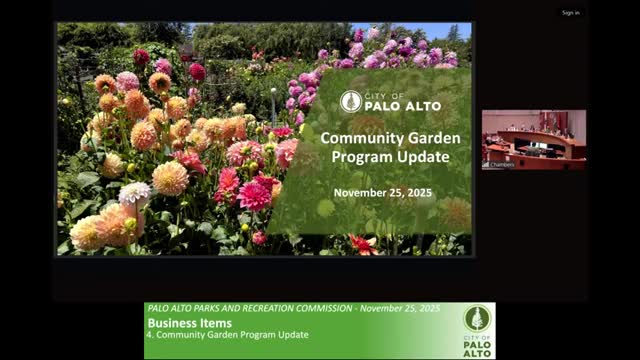
Summary
Recreation staff told commissioners the city manages five community-garden sites with more than 420 plots, described volunteer support and discounts, and answered questions about wait lists, enforcement and program guidelines.
Eric Bridal, Palo Alto’s recreation coordinator for open space, told the Parks and Recreation Commission on Nov. 25 that the city’s community-garden program emphasizes organic practices, volunteer stewardship and equitable access. "The Palo Alto Community Gardens are places where gardeners adhere to organic gardening principles," Bridal said, describing a program that now covers five sites and more than 420 plots.
Bridal outlined the five sites—Rinconada, Eleanor Pardee, Johnson, Ventura and Rastro de Oro—and the program’s operations. Rinconada is the largest with about 195 plots and high foot traffic because of its proximity to the Rinconada Library and Palo Alto Art Center. Eleanor Pardee and Rinconada host the city’s demonstration and monarch way-station plantings. Volunteer liaisons help manage wait lists, enforce guidelines and report maintenance needs; Bridal named several liaisons by first name, including Annie, Chanda and Kavita at Rinconada.
On fees and financial assistance, Bridal said plot billing follows the municipal fee schedule and that the city charges "96 cents per square feet"; water is provided at no additional cost. A one-time refundable deposit is $213. The city offers three discounts: a 25% senior discount (age 60+), a 50% income-based fee reduction, and a volunteer-liaison waiver that eliminates plot fees for a year. Bridal noted the program does not combine discounts.
Commissioners pressed staff on operational and policy details. When asked whether rodenticides are used in the gardens, Bridal answered, "No. We do not use rodenticides in the gardens." Commissioners also sought wait-list and enforcement details: Bridal gave a garden-by-garden snapshot (Rinconada ~22; Eleanor ~8; Johnson ~17; Ventura ~9; an "any garden" list ~6) and described the removal/enforcement process—staff sends notices, provides a 30-day correction period and may proceed to termination after additional notice; wait-list applicants are contacted twice and removed after two missed offers.
Bridal said volunteers and partner organizations supply much of the program’s labor and education. The Palo Alto demonstration garden works with UC Master Gardeners of Santa Clara County; Bridal said master gardeners contributed more than 1,600 volunteer hours over a 12‑month period and that 560 pounds of produce were donated to the downtown food closet. Hands On Bay Area and corporate volunteers (Bridal cited SAP and Salesforce) also assist with maintenance projects.
Public comments reinforced the outreach and education role of the demonstration garden. Edith Flynn, co-lead of the Palo Alto Demonstration Garden, described monthly classes on the first Saturday of the month and weekend open-garden hours, and asked for improved restroom access at Eleanor Pardee to support school and youth programs.
Bridal said the garden guidelines are available on the city website (staff flagged the latest published update as 2021) and that the department will email the commission the guideline document. He also described plans to convene a regional resource-sharing group with neighboring cities in early 2026 and expand use of volunteer partners beyond Eleanor Pardee.
The commission thanked staff for the report and asked staff to return with data on first-time visitors to activation events and additional guidance on program enforcement and outreach. The commission opened public comment but had no additional speakers on the topic.
Next steps: staff will circulate the program guidelines to commissioners, continue outreach to volunteer partners, and provide monitoring updates in upcoming reports.