
Santa Barbara Fire Department presents Standards of Cover study recommending paramedics, station studies and staffing increases
Get AI-powered insights, summaries, and transcripts
Subscribe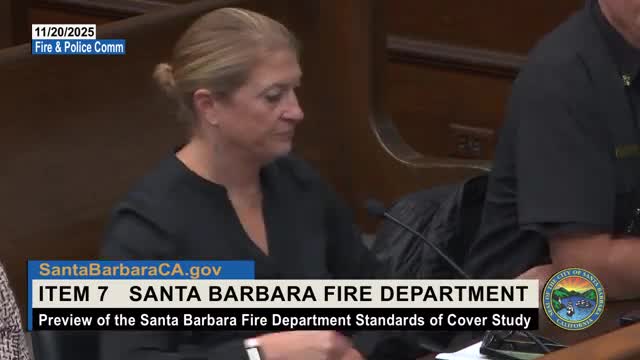
Summary
Fire Chief and consultants presented a Standards of Cover study recommending strategic ALS (paramedic) deployment, a facilities and station‑location study (Stations 3 and 7), additional EMS and training staff, expanded multilingual outreach, and consideration of adding 21 firefighters (one per engine) over time.
City staff and consultants on Wednesday previewed a multi‑year Standards of Cover (SOC) and Community Risk Assessment for the Santa Barbara Fire Department that recommends near‑ and long‑term changes to staffing, apparatus deployment and facilities to match evolving community risk, commissioners heard.
City Administrator Kelly McAtee introduced the SOC presentation and Chief Chris Mails described the study’s scope and data sources, noting the report began in 2022 and was completed in 2023 but delayed for staffing updates. The SOC reviewed calls across the city’s varied geography—from beaches to mountains—and made nine key recommendations for improving response capability.
Chief Mails emphasized station constraints and aging facilities, citing Station 3 (415 East Sola Street) as a 1929 state historic landmark whose apparatus bay cannot easily accommodate modern engines. He also noted Station 7 sits on two earthquake faults, creating near‑term relocation needs.
On emergency medical services, the SOC recommends moving from Basic Life Support (BLS) toward Advanced Life Support (ALS) by placing paramedics on strategically sited units. Chief Mails proposed starting with a two‑person paramedic quick response vehicle (QRV) downtown and placing a paramedic on Engine 71, rather than putting paramedics on every apparatus at once, to avoid compromising fire coverage.
The study also recommends hiring an EMS administrator to lead ALS quality assurance and medication oversight and adding an administrative assistant in training to free battalion staff for operational duties. Consultants recommended improving records management, expanding multilingual public outreach (English and Spanish), launching a community risk reduction program and creating a capital equipment/replacement plan.
A major staffing recommendation is adding one firefighter per apparatus to create four‑person engine companies citywide (about 21 FTEs excluding the airport). Chief Mails said consultants estimated the annual cost of adding those positions at more than $4,000,000 and emphasized the need for a phased approach tied to facility upgrades and funding strategies.
Chiefs and staff described short‑term work already underway—remediation at Station 6, reinstating a fire inspector position and completing the transition to a regional dispatch center—and outlined next steps: present the SOC to City Council on Dec. 9, develop a scope for a station‑location and feasibility study in 2026, and identify funding and potential federal or interagency partners for station relocation in 2027.
Commissioners asked who performed the SOC (AP Triton, a firm led by retired fire chiefs) and how priorities were set; staff said priorities were a collaboration between consultants and department leadership. Commissioners also asked why Santa Barbara historically lacked ALS while nearby communities have paramedics; staff said prior administrative/budget choices and changing regional ambulance dynamics likely contributed and that the SOC provides a neutral analysis to guide change.
Next steps: staff will prepare a feasibility/station location scope, seek funding options and return refined proposals to the council and commissioners; no personnel or budget decisions were finalized at the meeting.