
USDB committee opposes removing campus options, asks legislature to study funding changes
Get AI-powered insights, summaries, and transcripts
Subscribe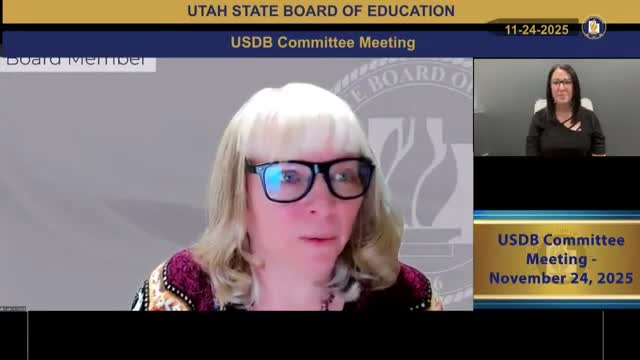
Summary
Following public comments from parents and staff briefings, the Utah Schools for the Deaf and Blind standing committee unanimously voted to send a revised response to PEA recommendations to the full board, urging retention of current service options (including students with Section 504 plans), cautioning against a straight WPU funding shift, and asking for a study of a USDB-specific weighted WPU and clearer timelines for data changes.
The Utah Schools for the Deaf and Blind (USDB) standing committee on Nov. 25 agreed to send a revised response to the State Board addressing recent Public Education Appropriations (PEA) recommendations and related audits, saying the legislature should study funding changes before restricting current campus options.
Chair Leanne Wood opened the special meeting saying the committee had been asked to evaluate recommendations that came to the Executive Appropriations Committee and to prepare material the full board can use in legislative drafting. After public comment and staff briefings, the committee moved and approved a referral to the full board for discussion, review and approval, including technical edits and an accessible version for the public.
Why it matters: parents, advocates and some board members warned that language in the PEA memo that would “limit comprehensive services” risks restricting student access to campus programming and language-rich environments. Several parents said those services — campus programs, outreach, USIMAC-accessible materials, bilingual supports and related therapy — are essential for students who are deaf, blind or deaf-blind.
Parents and community speakers told the committee that changes could curtail services or parent choice. Alicia Ensign, a parent active with the deaf community, said the phrase “limit comprehensive services” in the recommendations was a “red flag” that could restrict services and options. Roberta Dunlap, a third-generation deaf parent, urged the board to preserve the bimodal bilingual model and campus-based supports, citing research on early language access.
Board and staff discussion centered on three topics: placement and legal authority, funding models, and implementable timelines for data and census changes. Deputy Superintendent Lia Voorhees walked members through differences between Section 504 accommodations and IDEA IEPs, stressing that IEPs determine placement while 504 plans typically describe accommodations; she also clarified that Utah’s practice currently allows students with 504 plans to attend USDB programs using state (not IDEA) funds.
On funding, the group reviewed the PEA recommendation to include USDB-designated students in the regular K–12 WPU and the special-education add-on. Staff cited an approximate estimate in the PEA rationale that including roughly 325 full-time-equivalent campus students in the WPU could increase WPU costs by about $4,000,000. Committee members and USDB staff warned that a WPU-only model would not capture operational costs for programs such as USIMAC, deafblind services, parent-infant programming, audiology and other specialized services.
"We want the legislature to understand we value the partnership and the work done so far, but we must make sure ongoing programs are funded adequately," Vice Chair Randy Booth said before moving the referral motion.
Several members urged adding language recommending a study of a USDB-specific weighted WPU that could better reflect the higher per-student costs of campus-based special programs. Board members asked staff to provide cost modeling and options for the full board to review.
On timing, staff warned that vendor and student information system changes required to include USDB-designated students in the state October census are substantial and likely infeasible by August 2026; staff proposed moving that inclusion to fiscal year 2028 to allow time for IT updates and vendor coordination.
The committee also discussed facilities and course offerings. Members rejected language that would require the legislature to approve routine course offerings, saying curriculum and program decisions are a board/LEA responsibility; they asked the legislature to clarify what constitutes "specialized space" for capital decisions and emphasized continuing partnerships with local LEAs for shared facilities.
Formal action and next step: Member Randy Booth moved that the committee send the draft response to the full board for discussion, review and approval, with technical edits and an accessible public document. The motion passed by voice vote and the committee then unanimously approved an adjournment. The full board will review the committee’s recommended response and any technical changes before sending material to the Executive Appropriations Committee.
The meeting record shows the committee asked staff to prepare more specific cost and funding analyses, and to refine timelines for any data/system changes. The committee also preserved the option for students with a hearing or vision loss who have an IEP or require Section 504 accommodations to attend USDB programming when their IEP/504 teams determine that placement is appropriate.
The committee’s response and the staff analyses will be placed on the full board’s agenda for review and possible forwarding to the legislature.