Get Full Government Meeting Transcripts, Videos, & Alerts Forever!
Get email alerts on the Enrollment topic
No spam. Unsubscribe anytime.
Wenatchee School District projects multi-year enrollment drop, warns of budget and facility impacts
Summary
District finance staff presented data showing declining birth rates and a 76% kindergarten capture rate that produce the district's smallest recent kindergarten class and a model projecting about an 880-student loss over five years; board members said forecasts will guide forthcoming budget reductions and facility planning.
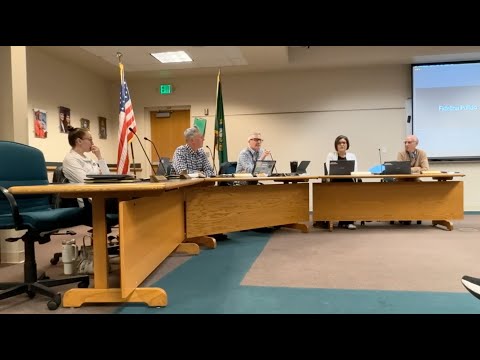
Sean Fitzgerald, the district’s executive director of business and finance, told the Wenatchee School District board on Oct. 28 that a combination of lower birth rates and falling capture rates is driving a multi-year enrollment decline that will affect revenue and long-term planning.
“We’re looking at over a decline of about 880 students over the next 5 years,” Fitzgerald said as he reviewed the district’s enrollment analysis and forecasting models. He told the board the district’s annual average full‑time equivalent (AA FTE) enrollment determines roughly 75% of state apportionment funding, and that sustained decreases matter to the budget.
Fitzgerald highlighted two concrete drivers: a decline in births in the district area (a year‑to‑year drop of 71 births from 2019 to 2020) and a current kindergarten capture rate of about 76 percent. The district’s most recent incoming kindergarten class is about 380 FTE, making it the smallest cohort in roughly a decade. Using the district’s current assumptions, Fitzgerald said kindergarten classes are likely to remain below 400 FTE through 2029–30.
Those cohort dynamics, combined with running‑start enrollment changes and expanding charter and private school options in the valley, create a forecasted cumulative decline that will reduce the district’s student head count and related funding. Fitzgerald noted some areas of growth — for example, Valley Academy’s recent expansion and an increase at the ninth‑grade level — but said those gains do not offset the longer trend.
Board members pressed for follow‑up detail. They asked for classroom overload counts at elementary schools, comparisons with neighboring Douglas County, and a timeline for an external demographic study by Davis that the district expects to resume in February or March. Staff committed to providing specific classroom overload figures within days and reiterated that the Davis demographic update will be incorporated into future planning.
The board also discussed how the forecast affects facility planning and a potential bond for a new high school. Board members said the district must avoid designing facilities solely for a transient enrollment bottom and instead build for long‑term capacity while remaining responsive to changing demographics.
Next steps the board identified include updating forecasts as new birth and capture‑rate data arrive, incorporating the Davis demographic study results when available, and using the report to inform upcoming budget‑reduction conversations and facility planning sessions.