
St. Louis town hall explains expanded RECA coverage and where residents can get help
Get AI-powered insights, summaries, and transcripts
Subscribe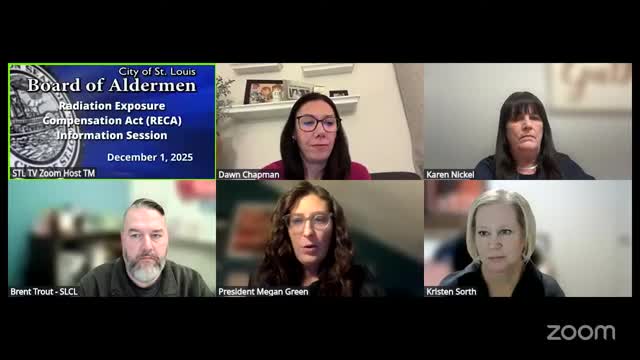
Summary
Panelists at the city’s first town hall on RECA expansion walked residents through who qualifies, the evidence they’ll need, how to file a Department of Justice claim and local resources — Saint Louis County Library, Pink Angels Foundation and Just Moms STL — to help collect and certify records.
St. Louis held a virtual town hall to explain the recent expansion of the Radiation Exposure Compensation Act (RECA) and to walk residents through eligibility rules, documentation requirements and local help for filing claims.
Dawn Chapman, co‑founder of community group Just Moms STL, opened the session with a summary of the program’s local relevance and national record of payouts. “RECA is a real program, and it has been around for 35 plus years,” Chapman said, noting that RECA has paid more than $2 billion nationally and that, since the local expansion, more than $12 million has been paid to people in the St. Louis area who completed applications.
Why the program matters: RECA provides either reimbursement for documented out‑of‑pocket medical costs or a one‑time, tax‑free payment. Under the Manhattan Project Waste claim rules described by panelists, living, working or attending school in a covered ZIP code for a total of 24 months or more after Jan. 1, 1949, plus a qualifying primary cancer, is the basic path to eligibility. A qualifying claimant may choose a one‑time tax‑free payment of $50,000 or reimbursement for eligible medical expenses; survivor benefits were described as a one‑time, tax‑free payment of $25,000 to the surviving spouse or equal shares to surviving children where no spouse survives.
What counts as a qualifying illness: The list of covered conditions comes from the Department of Justice. Panelists read the DOJ list and emphasized that cancers must generally be primary (the original site) and have onset at least two years after exposure; there are special age rules for certain leukemias. Organizers said the list is specific and limited to what DOJ has defined for Manhattan Project Waste claims.
How to apply now: Claimants must file a Manhattan Project Waste claim with the Department of Justice using the RECA claim form. Panelists said the form remains a paper filing at present — downloadable from the DOJ RECA site, Senator Hawley’s resources and local RECA pages — and should be mailed with supporting documents. “They are going to reach out to you with the claim number,” a panelist said, explaining that claimants typically receive written confirmation with a claim number and may get follow‑up by phone, mail or email.
Document and evidence help: Saint Louis County Library has set up a RECA portal and a residency documentation lookup request to find and certify documents such as long‑form birth and death certificates, yearbooks, directories, voter records and property tax pages. Brent Trout, manager of the library’s History & Genealogy Department, said the library can certify documents it can access and will email certified documents with a cover letter; turnaround for a lookup request is roughly two to four weeks. Trout cautioned that libraries cannot certify medical records or many school records and that some vital records requests through government agencies can take three to four months to fulfill.
Practical tips and pitfalls: Panelists urged claimants not to over‑supply decades of paperwork, to use official channels for vital records (not pay large service fees to third parties), and to consider certified mail when sending sensitive materials. On digital documents, the presenters advised that electronically generated copies are typically treated as copies and that requesters should ask the issuing company for a certified version when possible; they also said claimants can submit what they have and wait for DOJ to request additional proof if needed.
Help beyond the Zoom: Local nonprofit Pink Angels Foundation (a location in Florissant, phone provided during the session) and Just Moms STL are offering appointments and hands‑on assistance. Panelists said they plan in‑person outreach after the new year at community locations, and advised people without internet access to use library branches or host community meetings where organizers can come on site.
Next steps and timeline: Organizers emphasized that the local outreach effort is just beginning. They reminded residents that the current statutory expansion is limited in time (panelists said it will last for two years unless reauthorized) and urged eligible people to begin gathering documentation promptly. For questions, the panelists provided local contact addresses and encouraged residents to email westlakemoms@gmail.com or the city contact shared during the session.
The town hall closed with a reminder that panelists and library staff will continue answering questions and supporting application work in follow‑up sessions and in‑person office hours.