Wyoming Secretary of State asks legislature for $125,000 to publish 2026 property-tax ballot initiative, cites statutory duty
Loading...
Summary
The Secretary of State told the Joint Appropriations Committee the office must pay statutorily required newspaper notices for a certified 2026 property-tax initiative and requested a $125,000 exception; staff also sought three business-division positions and IT funding to handle surging filings.
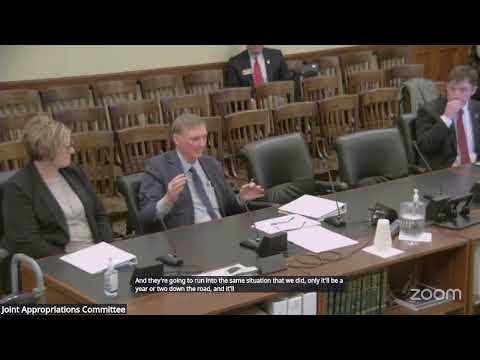
Chairmen and members of the Joint Appropriations Committee heard a detailed budget presentation from the Secretary of State’s office that included a $125,000 exception request to cover statutorily required publication costs for a certified 2026 property-tax initiative and multiple staffing and IT requests to handle rapid growth in business filings.
The Secretary said the office has generated “over $130,000,000” in revenue in the last biennium on a budget under $10 million and projected roughly $78.5 million in revenue for the current fiscal year. He described the publication request as a statutory obligation and explained the Legislative Service Office advised the office to include a known expense for publication as an exception request. "This is a required duty of the state, and I'm determined to make sure this is done properly," the Secretary said during his presentation.
The request is based on precedent and a per-line newspaper cost calculation used for constitutional amendments, according to Joe Rubino, policy director and general counsel. Rubino told the committee that statutory publication requires 12 consecutive weeks of local newspaper publication in each county and three weekly statewide publications within 30 days of the election, and that the $125,000 estimate reflects those per-line costs drawn from prior fiscal notes and past budget footnotes.
Several legislators questioned whether the office could absorb the publication expense within its existing $9.58 million standard budget or via administrative budget transfers (B11s). Senator Larson and other committee members argued the money might be found elsewhere in the office’s broad categories, while the Secretary responded that critical systems—such as voter registration and campaign finance systems—are funded and cannot be used without risking operational failures during the primary. He said the office will explore transfers but emphasized that, if denied, the statutory obligation could prompt further legal steps.
In addition to the ballot-publication exception, the office requested three new positions for the business division—two senior office support specialists (BAA SO-7) and one senior consumer affairs specialist (BACA-08)—and associated TRP (technology replacement program) funding for hardware and software. The office described a roughly 20–23% year-over-year increase in filings (over 830,000 filings in the last fiscal year) that has strained staffing models and justified higher classifications for positions. Colin Crossman, deputy and former business-division director, described automation gains but said the more complex filings and fraud investigations require higher-level staff.
Micah Fafi, director of administration, requested $57,470 for database storage growth hosted by Enterprise Technology Services (ETS) and $56,698 in TRP funding to replace worn peripherals and renew subscription-based software licenses (Microsoft Office and Adobe Acrobat). Kelly James, compliance director, requested $13,443 in spending authority from the securities fund for the consolidated lead evaluation reporting system used in securities investigations and asked for continued spending authority to replace funds from a dissolved national investor-protection trust so the state can maintain investor-education outreach.
Committee members also probed the office’s use of the Bucking Horse and Rider trademark and the $50,000 biennial royalty from the University of Wyoming. The Secretary and staff said the MOU with the university manages the mark and the funds support promotion and trademark protection; they explained enforcement actions are handled in coordination with counsel when necessary.
The Secretary framed several requests as preservation of statutory duties and service continuity, while committee members pushed on whether some costs are properly exception requests or could be covered through internal reallocations. The committee did not make a final appropriation decision in the hearing; the requests will be addressed in subsequent markups and votes.