Get Full Government Meeting Transcripts, Videos, & Alerts Forever!
Get email alerts on the Winter Contingency topic
No spam. Unsubscribe anytime.
Council approves winter-contingency shelters, allocates $1.6 million; Aspire to operate family and warming sites
Summary
The City-County Council’s Public Safety Committee approved Proposal 3-46-2025 to fund winter-contingency shelters and warming centers, including a Dec. 1–March 31 family shelter at North Tibbs and a weather-activated warming center at West Morris; OPHS requested $1.6 million and cited a roughly $2.4 million operating contract with Aspire Indiana Health.
The Public Safety and Criminal Justice Committee voted Nov. 19 to fund the city’s winter-contingency plan, approving an appropriation request to support two 24/7 shelters for this winter and a weather-activated warming center.
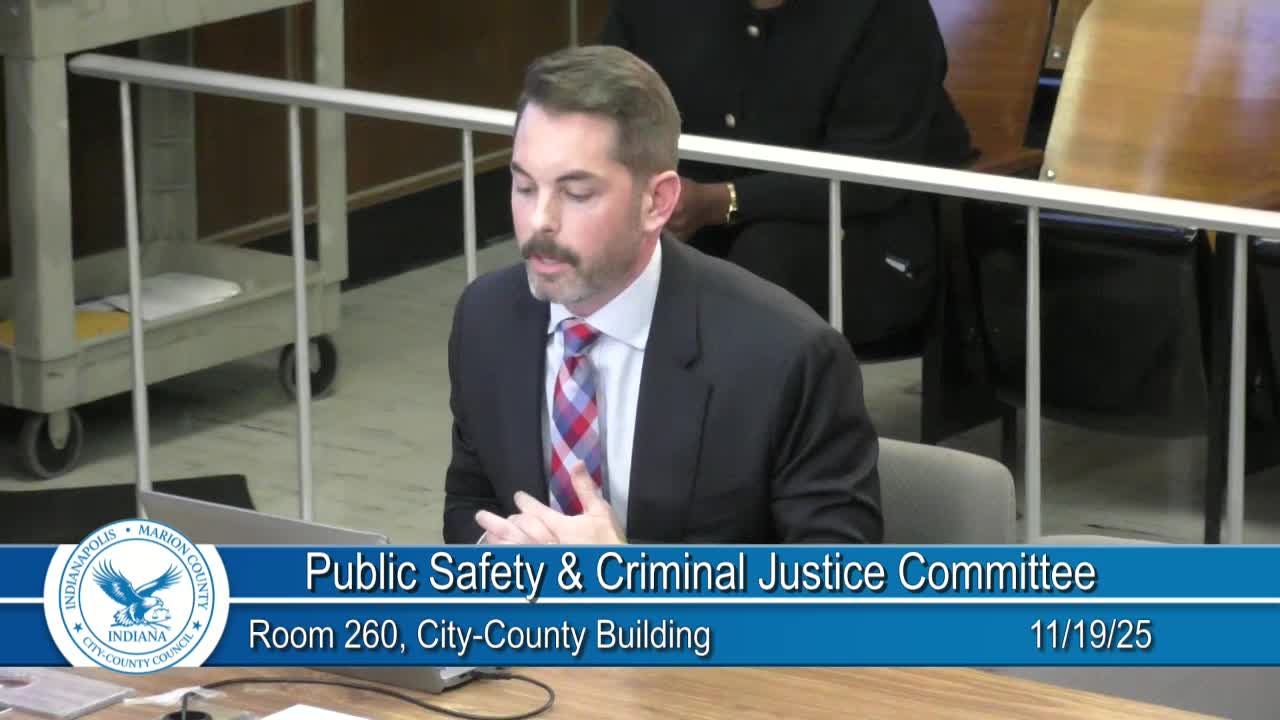
Andrew Merkley, director of the Office of Public Health and Safety, told the committee the city will open a family shelter at 2406 N. Tibbs Ave. and operate an overnight warming center at West Morris Free Methodist Church. “Starting Dec. 1 through March 31, it will be 24/7,” Merkley said, adding the family site can provide up to 160 beds for 40 families and 10 beds for single women. He said the Assessment & Intervention Center (AIC) will again provide 30 beds for single men.
Why it matters: the plan expands last year’s pilot by adding a family-specific site with private pod units and by lowering activation thresholds for the warming center. Merkley said the city’s planning group moved the start date from Nov. 1 to Dec. 1 after comparing regional models and recent weather patterns.
Key details and operations
- Funding: OPHS requested $1,600,000 for winter contingency operations; Merkley said the city’s contract with Aspire Indiana Health to operate the sites is roughly $2,400,000 and that Aspire will manage subcontractors, staffing and supplies. (Proposal: 3-46-2025.)
- Facilities and capacity: North Tibbs (family shelter) — up to 160 beds (40 family pods of four) and 10 beds for single women; AIC — 30 beds for single men; West Morris (weather-activated overnight warming center) — up to 70 beds when activated. Merkley said tents/pods with 7-foot walls will provide privacy for families.
- Activation and threshold: the warming center activates when the air temperature is 25°F or below, or when precipitation combines with a sustained wind-chill threshold; decisions will be made by 8 a.m. each day in consultation with the National Weather Service and city emergency services.
- Services and safety: Aspire will provide three meals daily at the family shelter, laundry, on-site behavioral and physical health services (including a mobile clinic two days per week), workforce navigation, and security staffing with background checks for volunteers. Merkley said two security officers will be present at each site at all times.
Council questions and community partners
Council members raised transport, accessibility and operational concerns. Merkley said bus routes serve both locations, Aspire will have access to a city Lyft account for transport, and McKinney-Vento liaisons will help families maintain school connections for children. Kathleen Bowers, director of housing services for Aspire, said winter contingency is low-barrier and focused first on survival and safety, then on connecting guests with permanent housing and services.
Community organizations represented at the meeting — including United Way, CHIP and Aspire — emphasized the multi-agency planning process. Sarah Van Slymbrook of United Way described broad philanthropic support and said stakeholder input informed the December start date.
Vote and next steps
The committee voted to approve the proposal by voice vote. Merkley said council members will be invited to tour the shelter sites before activation and that OPHS will publish contact information on-site for complaints and coordination. The city plans daily activation decisions with public notifications through media tickers, social channels and partner organizations.